

 RealGM Analysis
One of the most compelling crossroads in terms of decision-making in the NBA centers on the fourth year of a first round pick’s career. This time proves important because it sets the table for the pivotal series of events concerning the most important contract the majority of players who make it this far ever consider: their second.
In the last CBA and the early stages of the current one, we have seen a general trend of certain players getting extension offers and many of them taking it while other players hit restricted free agency the following summer to varying results. What makes this situation so interesting is that the RFA tag (and the rights-holding team’s ability to match any offer due to Bird rights) clearly depresses the market for contracts at this stage. Players like Josh Smith took a hit thanks to a constricted market where teams feared losing a valuable week of cap space since teams have a week to match offers, leading agents and players to settle for offers lower than what the player could have gotten in unrestricted free agency. Furthermore, some of these players, including Smith, ended up being retained by their current team in situations they might have left if they had the full flexibility to choose their favorite offer without the matching provision. Even though the matching time shrank to three days in the new CBA, many of these chilling factors have been unchanged.
Keeping all of those factors in mind, one contractual option has been wholly underutilized by players coming out of their rookie deal: accepting the one-year tender and becoming unrestricted free agents the following year. If we were talking about a sport like the NFL with a more ever-present risk of serious injury, the downside possibility of losing a substantial amount of money would necessitate greater pause. After all, the risk in a true contact sport of getting a career-altering injury is much higher than today’s NBA where even an ACL tear usually means a full recovery for a young player with a bright enough career to have these choices.
The benefits to taking the offer should be somewhat clear: a true and open market coupled with the ability to choose the best offer and situation without any strings. The tweaked rules with sign-and-trades actually make it even easier since a player leaving his previous team has no incentive to get leveraged by that organization if his potential new employer has the space to sign him outright. There could and likely would be games in circumstances where the prospective new team needs some help to create the space to get him, yet that provides no meaningful disadvantage over doing the same when a player is restricted. In fact, it gives the acquiring team even more options since matching is off the table.
Over the last few seasons, we have only seen one prominent player take this route coming off their rookie deal: Ben Gordon. There are a few different reasons why it has happened so rarely, with one of the biggest being a serendipitous series of players ending up in situations where they were more willing to sign an extension. Derrick Rose got drafted by his hometown team and has a quality supporting cast around him while Kevin Durant and Russell Westbrook form the core of the Western Conference’s brightest powerhouse.
We are now embarking on a time where similarly incandescent talents play in less luminous circumstances. Each of the following players could use signing their tender offer and becoming a UFA the following year to put themselves in a better overall situation.
Here are some players who face interesting decisions along these lines, separated by the year they will have to make their decision:
Summer of 2012
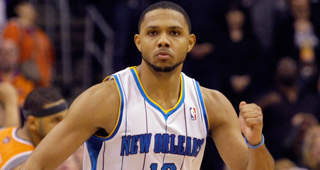
Eric Gordon- The man currently standing as the best young starting shooting guard in the league (almost by default) runs the risk of having a contract matched by the shipwrecked Hornets franchise. The biggest risk here goes beyond money and into the realm of pride/hubris: since David Stern rejected the original Chris Paul trade “for basketball reasons,” things have turned sour on the final trade with the Clippers. As the centerpiece of said trade, it would be horrible PR for the Hornets to lose the jewel less than one year after the deal was consummated. As such, waiting a year and hopefully rehabilitating concerns about his injury history would allow Gordon to find the best situation moving forward. The risk of his stock being tanked by the continuing injury bug will lead to pressure to take the money now and run, regardless of where it leaves him.
Brook Lopez- While we are talking about players at the trough of their value, Brook Lopez likely ambles into a free agent market poorly suited for him in many ways. First off, his injury woes this season have put a damper on some pretty hearty buzz. Secondly, the crop of teams with cap space other than his current employer (which has other players in mind) paint a more stark picture than a potential free agent run in 2013. That said, the Brooklyn Nets could be pressured into giving Lopez plenty of money to be the shining star of the team as they move if Deron Williams heads home to Dallas this summer. Lopez’s decision will say a good deal about what is most important to him in his next contract.
Ryan Anderson- Anderson is in exactly the opposite situation as Lopez. While he could still improve, this off-season could very well mark the best “sell high” point for Anderson in the next few seasons. The reason to consider waiting until 2013: the possibility that Dwight Howard leaves the organization in shambles next summer. Being a power forward on a largely broken team whose best player leaves as a UFA does not sound particularly appetizing even in a state with no income tax. Perhaps the most compelling decision in this group.
Roy Hibbert- How often do we see an All-Star true center hit unrestricted free agency before the age of 27? Hibbert has the chance to capitalize on getting teams to prepare to sign him as an UFA through tools like the amnesty provision and teams would line up around the block for the privilege.
JaVale McGee- Perhaps the most interesting “buy low” candidate in quite a few seasons. McGee has the talent to become a valued contributor at the rarest position to have that kind of player and needs some time to build up his reputation, particularly if the rumors on his outlandish salary expectations are correct. Another risky proposition since it seems likely some team will panic-offer him this summer and Denver would be a worthwhile landing spot if they choose to match.
Summer of 2013
Blake Griffin- Griffin could shatter the Space-Hype Continuum or simply retain the option of returning home to a quality organization that should have plenty of pieces to offer for a sign-and-trade if Chris Paul heads to Dwighter pastures in 2013.
Stephen Curry- He plays on the Golden State Warriors, consistently one of the most combustible situations in the league. The only way he retains the ability to run like hell if things go bad is to become an unrestricted free agent in 2014. It could be worth taking the risk of his ankle problems tanking his value to retain that option, especially if going home to Charlotte (who by this point would have two more high lottery picks) is as interesting to Curry as he has made it seem in interviews.
James Harden and Serge Ibaka- Both players could parallel Josh Smith’s RFA summer in the sense that teams would hesitate to make offers since Sam Presti and Oklahoma City management are so high on each of them. Either or both could potentially get more compelling offers by waiting another year and adding leverage.
Brandon Jennings- If Jennings wants to head to a big market soon, the easiest way to do so is in 2014. Simple as that.
Jeff Teague- Does anyone want to be on the Hawks when Joe Johnson still takes up a metric ton of their cap and studs like Smith and Horford will have the flexibility to leave? I doubt it.
Taj Gibson- Unrestricted free agency might be the only chance he has in the next few years to get a starting spot in the league. Not sure if that is what he wants in his second deal, though I’m sure coming off the bench behind Carlos Boozer could get old over the next two seasons even as the team thrives.
2014 and Beyond
Ricky Rubio- El Catalizador would be just 25-years-old as an unrestricted free agent in 2016. Taj Gibson was 24-years-old when both of them were drafted in 2009. Horrifying.
John Wall- Hopefully the Wizards are in a much better place by that point in time. The only way the Wizards do not match an offer to an RFA Wall would be injury or Arenas Part Deux. If he wants out, he has one option.
DeMarcus Cousins- I talked in Roy Hibbert’s section about what the market would be like for a young, elite center prospect in the unrestricted market. I shudder to think at the options a talent supreme like Cousins could have if the Kings do not get lucky in the lottery over the next few seasons. In 2015, Cousins could have former teammate John Wall and any or all of the Miami trio to combine with and any number of teams falling over themselves to make it happen.
Greg Monroe- See above, except Monroe likely will be playing in a worse team/organization situation at that point.
Paul George- George could be an All-Star by this point despite playing out of position and would have some incredibly fun teams pursuing him if Indiana missteps over the next two seasons.