May 03, 2013 5:35 PM EDT 
For the third consecutive year, RealGM presents the most outstanding players of Euroleague.
Victor Khryapa of CSKA Moscow is the winner of the RealGM Euroleague MVP award for the 2012-13 season. The 30-year-old forward has improved all of his main statistical numbers this season, averaging 10 points, 7.5 rebounds, 3.8 assists and 1.6 steals per game. Khryapa has also helped his team, which holds a 23-5 record this season, to defeat Caja Laboral Vitoria in the playoffs to reach the Final Four.
For the second consecutive year, the RealGM Euroleague MVP award was given to a Russian player, as the winner of last season's prize was Andrei Kirilenko of CSKA Moscow.
The RealGM All-Euroleague First Team consists of Montepaschi's Bobby Brown and Olympiacos' Vassilis Spanoulis at guard, Khryapa and Maccabi's Shawn James at forward and CSKA's Nenad Krstic at center.
The RealGM All-Euroleague Second Team includes guards Jordan Farmar of Anadolu Efes and Zoran Planinic of Khimki, forwards Rudy Fernandez and Nikola Mirotic of Real and center Ante Tomic of Barcelona Regal.
Paul Davis of Khimki Moscow region is the winner of the Euroelague Rookie of the Year Award, while Aron Baynes (formerly of Union Olimpija before joining the San Antonio Spurs) was the RealGM pick to win the Most Improved Played Award.
Georgios Bartzokas of Olympiacos was named as the 2012-13 Euroleague Coach of the Year, while Kyle Hines (also from Olympiacos) is the winner of the 2012-13 Euroleague Sixth Man of the Year Award.
Euroleague MVP
Victor Khryapa (CSKA)
All-Euroleague 1st Team
Bobby Brown (Montepaschi): 18.8 points, 5.3 assists in 33 minutes
Vassilis Spanoulis (Olympiacos) - 14.7 points, 2.1 rebounds and 5.6 assists in 30 minutes
Victor Khryapa (CSKA) - 10 points (45% 3FG), 7.5 rebounds and 3.8 assists in 28 minutes
Shawn James (Maccabi): 11.5 points (64% 2FG), 6.5 rebounds in 24 minutes
Nenad Krstic (CSKA) - 13.6 points (63% 2FG), 4.6 rebounds in 24 minutes
All-Euroleague 2nd Team
Jordan Farmar (Anadolu Efes): 13.8 points, 3.6 rebounds and 3.9 assists in 30 minutes
Zoran Planinic (Khimki): 12.4 points, 3.9 rebounds and 6.3 assists in 31 minutes
Rudy Fernandez (Real): 13.6 points, 3.8 rebounds and 3.1 assists in 27 minutes
Nikola Mirotic (Real): 11.7 points, 5.5 rebounds in 25 minutes
Ante Tomic (Barcelona Regal) - 11.5 points (63% 2FG), 6.3 rebounds in 23 minutes
Sixth Man Award
Kyle Hines (Olympiacos) - 9.1 points, 5.9 rebounds in 20 minutes
Most Improved Player Award
Aron Baynes (Union Olimpija) - 13.8 points, 9.8 rebounds in 26 minutes
Coach of the Year
Georgios Bartzokas (Olympiacos)
Rookie of the Year
Paul Davis (Khimki)
All-Rookie 1st Team
Paul Davis (Khimki) - 13.4 points, 5.5 rebounds in 20 minutes
Ricky Hickman (Maccabi) - 13.5 points, 2.7 rebounds and 3.1 assists in 29 minutes
Blake Schilb (Elan Chalon) - 15.5 points, 4.6 rebounds and 4 assists in 33 minutes
Marcus Williams (Unicaja) - 10.5 points, 2.7 rebounds and 3.3 assists in 22 minutes
Shelden Williams (Elan Chalon) - 11.3 points, 7.6 rebounds in 23 minutes
All-Rookie 2nd Team
Drew Gordon (Partizan) - 9.1 points, 7.5 rebounds in 29 minutes
Lukasz Koszarek (Asseco Prokom) - 11.1 points, 2.9 rebounds and 4 assists in 30 minutes
Kelvin Rivers (Khimki) - 9.6 points, 2.7 rebounds in 26 minutes
Dashaun Wood (Alba) - 9.8 points, 2.5 assists in 24 minutes
Maik Zirbes (Brose Baskets) - 8.2 points, 5 rebounds in 20 minutes
CSKA Moscow, Montepaschi Siena, Olympiacos, Maccabi Electra Tel Aviv, Anadolu Efes, Khimki BC, Real Madrid, FC Barcelona Regal, Union Olimpija, Chalon-Sur-Saone, Unicaja Malaga, KK Partizan, Asseco Prokom Gdynia, ALBA, Brose Baskets, Adriatic League Liga ABA, Austrian A Bundesliga, Balkan BIBL, Baltic Basketball League, Baltic League BBL Challenge Cup, Baltic League BBL Elite Division, BBL Cup, Belarusian BPL, Belgium BLB, Belgrade Tournament (NIJT), Bosnian BiH Liga, British BBL, Citta Di Roma Tournament (NIJT), Ciutat De L'Hospitalet Tournament (NIJT), Czech NBL, Danish Basketligaen, Dutch Basketball League, Estonian KML, Eurochallenge, Eurochallenge - Qualification, Eurocup, Eurocup - Qualification, Euroleague, Euroleague - Qualification, Finnish Korisliiga, French Leaders Cup LNB, French LNB Pro A, French LNB Pro B, FYR Macedonian Superleague, Georgian Super Liga, German BBL, Greek Cup, Greek HEBA A1, Hungarian NBIA, Irish Superleague, Israeli BSL, Israeli Liga Leumit, Italian Cup, Italian Lega A, Italian Legadue, Kaunas Tournament (NIJT), Latvian LBL, Lithuanian LKL, Macedonian Superleague, Montenegrin Prva A Liga, Netherlands DBL, Norwegian BLNO, Polish TBL, Portuguese LPB, Romanian Divizia A, Russian PBL, Serbian KLS, Siauliu Tournament (NIJT), Slovakian Extraliga, Slovenian SKL, Spanish ACB, Spanish Cup, Spanish LEB Gold, Spanish LEB Silver, Swedish Basketligan, Swiss LNA, Turkish TBL2, Ukrainian Superleague, Ukrainian UBL, VTB United League, International, International League, International Teams Aug 06, 2012 10:38 AM EDT
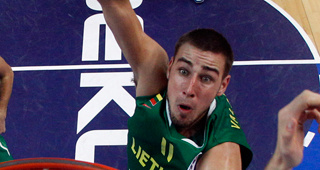
Neither Anthony Davis nor Jonas Valanciunas, the two youngest basketball players in the Olympics, were much of a factor in Team USA’s narrow 99-95 victory over Lithuania. Valanciunas, despite starting for Lithuania, played nine minutes while Davis stayed on the bench in the Americans' first tight game in London. If David Stern and Mark Cuban don’t get their way, that could be a very different story in 2016 (when Valanciunas would be 24 and Davis would be 23), 2020 and maybe even 2024, where they would both be younger than Kobe Bryant is now. Teenagers don’t aren’t generally involved in high-level international competitions, an indication of what Hubie Brown would call their “tremendous upside potential”. But while they both wound up as top NBA lottery picks, they took radically different paths to get there. It’s very Rocky IV: Valanciunas is the Ivan Drago character, signed to a professional contract in his adolescence. Davis is the raw American, emerging essentially from nowhere as a high school junior to become the best player in the country. Before his late growth spurt, Davis was an unheralded 6’4 perimeter player being recruited by mid-major colleges. Then he suddenly grew to 6’10 without losing any of his foot-speed. The result was the ideal combination of a center’s size and a guard’s quickness. Valanciunas is a more conventional big man, with excellent athleticism for a 6’11, 240 center. He was identified at an extremely young age as a promising prospect, a pro by the age of 16. Two years later, he was playing for Lietuvos Rytas in the Euroleague, the second best pro league in the world. At Kentucky, Davis was the defensive lynchpin of one of the most talented collegiate teams in a long time. The Wildcats had the No. 1, 2, 18, 29, 42 and 46 selections in the 2012 NBA Draft, and they were far too talented for most of their opponents. Their final record speaks for itself: 38-2, with only three of those wins (and none in the NCAA Tournament) coming by fewer than five points. Valanciunas, meanwhile, was playing with players twice his age. As a result, he was a role player, rarely creating his own shot. In that context, his 2012 Eurocup stats are fairly impressive: 10.8 points, 7.6 rebounds and 1.6 blocks on 63% shooting in 23 minutes a night. Davis was dominant at Kentucky -- 14.2 points, 10.4 rebounds and 4.7 (!) blocks on 65% shooting -- but it’s hard to imagine him having more success than Valanciunas if their roles had been reversed. When adjusted for pace and per-40 minutes, Valanciunas averaged 18.9 points, 13.4 rebounds and 2.7 blocks a game in 2012. He would have adapted easily to the role Davis had for Kentucky - running the floor, moving the ball and catching lobs at the rim. The talent gap between the Wildcats and the other 11 teams in the SEC was about as wide as the one between Team USA and the other 11 teams in London. Valanciunas, Terrence Jones, Michael Kidd-Gilchrist, Darius Miller, Doron Lamb and Marquis Teague would still have been a huge favorite to win the Final Four. Davis, a more fluid athlete, is the better defensive prospect. At 6’11, 220 with a 7’6 wingspan, his quickness, length and defensive timing allow him to be a dominant shot-blocker without getting in foul trouble (only 2.4 a game at Kentucky). In contrast, Valanciunas’ biggest problem next year will be his rate of 5.6 fouls per 40 minutes, an improvement from 8.2 per 40 in 2011. On the other side of the floor, Valanciunas has developed some basic post moves, which is all a player with his size and length (7’4 wingspan) needs to score. He used a jump hook to shoot over the top of Tyson Chandler and Ronny Turiaf in London, and while it didn’t always go in, all they could do was wave at the ball and hope he missed. Davis, meanwhile, will struggle establishing deep post position next year, so he’ll have to either get stronger or refine his perimeter jumper. Both are part of a new wave of big men of small-ball centers, making up for what they lack in pure strength with great length and lateral quickness. Neither has the bulk to bang with mammoth centers like Dwight Howard and Andrew Bynum, but they’re well suited to the more perimeter-oriented game the NBA is moving towards. Where they go from here is unclear: just because a 20-year old could grow into something doesn’t necessarily mean they will. Maybe Davis never adds any weight and drifts out on the perimeter, where his skill-set is less valuable. Maybe Valanciunas maxes out as a more skilled version of Andris Biedrins, a big man not good enough to dominate offensively or athletic enough to dominate defensively. Like almost all young centers, their development will depend heavily on the environment their team puts them in. Davis has a higher ceiling than Valanciunas, but the difference between the two isn’t nearly as high as their pre-draft publicity would suggest.
Jonas Valanciunas, Anthony Davis, Toronto Raptors, New Orleans Pelicans, Euroleague, Lithuanian LKL, NCAA, NBA, NBA NBA Draft, International, National, National Olympics, NBA Draft General, International League May 14, 2012 8:18 PM EDT
When I saw Ty Lawson knocking down three-pointers at the beginning Game 6 against the Los Angeles Lakers, it was difficult to believe it was the same Lawson who spent the first 95 days of his season in Europe playing for eventual Lithuanian champions Zalgiris Kaunas.
The same thoughts have surely been coming to Zalgiris’ and European basketball fans’ heads all season long as Lawson had a terrific year and established himself as an NBA star. Why didn’t Lawson meet expectations and was strictly a role player in Europe before having such a big impact in the NBA?
Back in July of last year, I wrote about the five reasons why Euroleague teams shouldn’t sign NBA stars and all five points could be easily applied to Lawson in retrospect.
Lawson simply wasn’t able to translate his game in Europe. Lawson, who is known for his quickness, driblle penetration and ability in transition, had to fit Ilias Zouros’ slow-paced positional, defensive game, which would be a nightmare for an player like Lawson. As a result, Lawson scored 52 points, dished out 11 assists and made six steals in 149 minutes (seven games) of Euroleague action.
In contrast, in his first 165 minutes (five games) in the NBA this season, Lawson’s numbers were more impressive - 93 points, 28 assists and 14 steals. Definitely, no defensive three-second violation had also prevented Lawson from driving to the basket, but as he is ranked highest (31st) in scoring among all NBA players, who played in the Euroleague during the lockout. It is clear that Zalgiris was not able to use all Lawson’s offensive potential.
Two weeks ago, after losing Game 2, Lawson seemed to be frustrated as he tried “to please everybody" and added that he "probably had 10 different people coming to him saying, 'Do this, do that' instead of just trusting his skills and playing himself". ‘Trust your skills and play yourself’ approach would have definitely helped him in Lithuania as well.
On the other hand, Lawson never was as aggressive in Europe as he is in the NBA and that was the feeling since his first Euroleague game against CSKA Moscow. For example, despite Lawson was only taking one three-point shot only every 19 minutes in Europe (compared to one every 11 minutes in the NBA this season), which is 1.2 attempt per game comparing to 3.1 in the NBA. He also didn’t dish out a single assists in the first two games in Euroleague.
Moreover, people who surrounded Lawson on the team always noticed that he had never been very motivated in Kaunas. RealGM was the first media outlet to conduct a one-on-one interview with Lawson, where the Nuggets’ point guard seemed to be excited about playing in Lithuania, but later on after getting familiar with European basketball, the excitement disappeared. Coaches getting fired after just one Euroleague game, two-a-days, unusual player rotations, lazy practices and playing for a losing team didn’t motivate Lawson to excel in Europe.
However, Lawson remained a professional off the court as well during his time in Zalgiris and usually tried to avoid expressing what he really thought with only a few exceptions. Once, Lawson shared his opinion about practices with Zalgiris on Twitter, where he wrote, “I coulda sat home and played NBA 2k12 and got the same thing accomplished that we did in practice smh.”
After returning to the United States, Lawson also revealed to the media that he didn’t understand European rotation system, where “you play four minutes, then you get subbed for 10, and later you have to get back on the court”.
The example of Lawson’s adventures in Europe just proves how unpredictable and different European basketball is in comparison to the NBA. But the positives outweighed the negatives for Lawson in Europe.
Back in September, Lawson told RealGM “probably the biggest difference I’m having is two-a-days. In Denver, we didn’t do that at all. This is getting me in shape".
Lawson was right - a tough schedule and the experience he gained in Europe helped him to get into shape for the NBA season - the best in his career. Lawson had excellent numbers, averaging 16.4 points, 6.6 assists and 3.7 rebounds per game in the regular season. Feb 02, 2012 We are past the halfway point in all of the European National Domestic Leagues and with January fully in the books, it is an opportune time to check in on team rankings for Spain, Italy, Greece, Russia, France, Turkey, Lithuania, Serbia, Croatia, Germany, Israel & more. |
|
Basketball Wiretap Headlines
|