May 17, 2013 12:45 AM EDT 
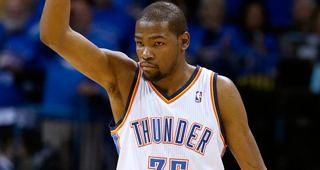
Kevin Durant missed some shots. Offensively he wasn’t the dynamo that carried the Oklahoma Thunder past the Houston Rockets. It’s hard to argue that Durant doesn’t need to be better next season for his team to return to The NBA Finals. But Oklahoma City’s second-round exit is hardly his fault.
Not even the injury to Russell Westbrook, a three-time All-Star, can be legitimately viewed as the sole reason the Thunder lost. It certainly played a role, but those that have watched the team all season understand that Westbook’s injury only made the team’s mistakes more visible.
The real failure belongs to Sam Presti and the Thunder front office. The franchise’s bright future was put at risk the moment they decided to trade James Harden.
It’s rare when a franchise finds a group of young players that are good enough and work well enough to compete for championships. Most teams are looking for two, the Thunder had three. Durant, Harden and Westbrook improved each season and the team improved around them. The next step was winning a championship. Presti, however, never gave that talented core a chance to keep going.
It’s a story that has a predictable outcome, mainly because it’s something we’ve seen before.
Think back to the 2008-09 Orlando Magic and their run to The NBA Finals. That tough, well-coached team never had a chance to make another run to The Finals. Moves were made during the summer that changed the dynamic and chemistry of the team. Vince Carter was acquired while Courtney Lee and Rafer Alston were shipped out. The mix was never right and Otis Smith, the former general manager of the Magic, would be forced to make more trades in search of a mix that would recapture the chemistry of the Finals team. Ultimately they would take steps back in the three following seasons, leading to Dwight Howard asking out and being traded to the Los Angeles Lakers. In just three years, they went from conference champions to a lottery team.
Who knows if the stars in Oklahoma City get frustrated and ask out at some point? Certainly not I, but it’s a safe bet that guys are interested in winning and they’re aware of the factors that hurt their chances to compete.
In the world of sports, things can change in a moment’s time. Nothing, especially winning, is guaranteed. Injury, free agency and complacency can all change the fortunes of a team. This year the injury bug caught the Thunder, who knows what’s next?
It’s important to cultivate assets while you have them and go for the win. The Thunder had three of the best assets any team could ask for. Those guys produced on and off the court; the risk was minimal. Perhaps they would need to make a change at some point, but that point wasn’t before giving Durant, Westbrook and Harden one more chance to make a run. Only then could Presti and the Thunder ownership truly evaluate whether the reward of keeping Harden outweighed the risk. In fact, the deal Presti made for Harden surely would have been available after the end of the season.
That team, at the very least, deserved one more shot.
Had the Thunder been patient and truly believed in the strength of their program, they would have discovered that Harden is better than good. So good, in fact, that he’s made Houston an attractive landing spot for upcoming free agents. Meanwhile, the Thunder are left with the burden of finding the right guys to get the team back to contender status.
The reality that nothing is guaranteed should have been incentive for Presti to roll the dice. Now, the conference is certain to change and the road to the NBA Finals could become much more difficult for the Thunder. Who knows where guys like Chris Paul and Dwight Howard land this summer? It’s a safe bet that both men will make a great impact on the conference.
Still, the biggest impact on the Thunder was made by Presti when he made that trade. It’s something that he’ll regret.
Apr 03, 2013 2:53 AM EDT
MILWAUKEE – When Sam Presti beat the trade deadline to acquire Ronnie Brewer, he had a vision of another wing defender the Oklahoma City Thunder could use in critical moments on Manu Ginobili or Kobe Bryant, and, ultimately, LeBron James. Brewer has come to the Thunder with a Tom Thibodeau pedigree and the reputation as a rigid defender, so much so that Luol Deng said late last season that Brewer was one of the best perimeter stoppers in the NBA.
There’s been a clear belief out of Scott Brooks about matching opponents’ physicality, and people around the Thunder believe that the physical play has heightened this season when they face Eastern Conference teams. They had a game last Wednesday, when the Chicago Bulls finally snapped the Miami Heat’s historic winning streak and laid out a blueprint centering on rugged defense and clean, hard fouls – but Thunder players still caught part of the fourth quarter in the locker room.
Yes, no one’s going to stop James right now, and Brewer would be conceding a couple inches and around 30 pounds. Even so, Brewer has shown in their past matchups that he has the lateral quickness, strong base and fortitude to stay with James.
Which begs the question: Could Brewer ultimately be the Thunder’s answer to defend LeBron in a possible Finals rematch?
“Hopefully,” Brewer told RealGM. “It’s not going to be ticky tack fouls. You don’t want guys running through the lane without being touched. If it was easy to score, everybody would be doing it and everybody would be very successful. … The Bulls didn’t make it easy for the Heat and it really showed.”
It was evident across the league, too. James left the game irked about the fierceness with which the Bulls played and how they punished him inside. Within the Thunder locker room, the hits were seen as playoff fouls, physicality that will be delivered both ways.
“That’s how Thibs plays,” Brewer said. “No matter who is out there on the court, he’s still going to get his guys to play hard, physical, night in and night out. I wasn’t shocked that that’s how they played because that’s how you play playoff-caliber basketball.”
Brewer has felt welcomed by his new teammates and already has tremendous respect for the fan base. As Brewer said, “Whatever this team is doing before I got here this year, it’s obviously working. They went to the Finals last year; 50-plus wins again this year.” Yet last season, they lacked a second defender who accepted sacrificing his offense to solely focus on losing energy, losing battles within a game guarding James.
Of course, Brewer has been a total non-factor on offense since the Thunder acquired him. He still works the baseline magnificently, but he appears hesitant to shoot jumpers and has attempted just seven shots in 52 minutes over nine games with the Thunder.
Thabo Sefolosha has made strides in his three-point shot, hitting a slightly lower percent than his 43.7 percent mark a season ago on twice as many attempts per game. In last year’s Finals, he spent most of the crucial defensive series guarding LeBron, but James refused – and still refuses – to settle and freight trained past Sefolosha or James Harden.
As the Thunder’s leader, Kevin Durant has taken the challenge to defend James at times in games, and yet it doesn’t have staying power because of the way James can post up and put him into foul trouble. The Thunder can’t afford to have Durant saddled with foul issues and they need Serge Ibaka blocking and altering shots at the rim – not chasing James around the perimeter.
“For a player like myself and Thabo, you just have to slow players down,” Brewer said. “That’s all you can try to do. Guys in this league are so talented that some nights it’s luck, where they’re not making shots and you just have to do different things.”
James is about to enter this postseason to cap off a season for his generation, continuing to maintain durability and refusal to be forced out of his comfort zones. No one is stopping him now, and some scouts believe these Thunder would have to run, run and run to outscore the Heat. Brooks insists they can play either style – with toughness or up-tempo pace – but he understands the East’s physicality.
“We know the East is a physical conference overall,” Brooks said. “We can play physical and have success or we can run the ball and try to score every 10 seconds. We can go either way.”
These games now allow the Thunder to sharpen for the playoffs, and they grasped a level of certainty from that Bulls victory over the Heat. This postseason will have all these brilliant wing scorers coming for Sefolosha and Brewer: James Harden and Ginobili and perhaps Bryant.
And the most potent of them all looms in the East, and Presti and the Thunder had to have traded for Brewer with this in mind. If they play LeBron and his Heat again, rest assured, Brewer comes from the Thibodeau system and comes with experience guarding James.
Mar 25, 2013 6:35 PM EDT In the nine years before Fred Hoiberg returned to Ames, Iowa State made the NCAA Tournament once. After taking over in 2010, the former Cyclone great turned things around immediately, making the second round in each of the last two seasons. In 2012, a team lead by Royce White gave Kentucky their only real scare of the Tourney. On Sunday, they came up just short against Ohio State in a controversial 78-75 nailbiter. The early returns are impressive, but Hoiberg's free-flowing and wide-open style of play is what has really caught the eyes of NBA GM’s. He could become the Chip Kelly of college hoops, unless the NBA grabs him before he has the chance to finish the job at Iowa State.
After retiring as a player in 2006, Hoiberg took a job in the front office of the Minnesota Timberwolves. His extensive background in the NBA gave him a distinct advantage when he returned to the Big 12, home to such 'brilliant' coaching minds as Rick Barnes, Scott Drew and Travis Ford. In order to turn the Cyclones program around quickly, he began bringing in transfers from all over the country. Most coaches wouldn’t have been able to integrate that many new faces, but Hoiberg assembled a team heavy on shooting, a quick way to make up for a lack of continuity. By playing five three-point shooters at once, Hoiberg spread the floor as wide as possible, the logical endpoint to the way the game has changed over the last generation.
The top six players in Iowa State’s rotation all took at least two three-pointers a game. Will Clyburn was the only one who shot less than 38 percent from the beyond the arc. Clyburn, an athletic 6’7 210 shooting guard, was the team’s best player; when he had the ball in his hands, defenses had to respect the other four players spread out along the three-point line. The result was huge driving lanes to take the ball to the rim, as well as space for everyone else to use when defenses collapsed. Iowa State’s offense was a beautiful mix of Mike D’Antoni and Don Nelson, designed to create enough space to exploit a mismatch at any position on the floor.
When they were executing and avoiding turnovers, the Cyclones were almost impossible to defend. They had an offensive rating of 111.8, 15th best in the country, despite having marginal talent for a Power Six conference. They don’t have a single McDonald’s All-American and only two players (Clyburn and Chris Babb) with clear next level potential. Scouting them was only so useful because they didn’t need to run any sets to get an offensive flow. They created space on the floor, trusted their players to win 1-on-1 match-ups and had everyone else in position to take advantage of the rotating defense. In short, Hoiberg allowed his players to play basketball and trusted them to make the right decisions from there.
It was a refreshing change from the vast majority of college offenses this season, which lacked the spacing or the skill-level to consistently execute in the half-court. It’s the same basic idea behind Kelly’s offense at Oregon: create tempo by using skilled athletes to attack in space and keep the defense off balance. Mike D’Antoni began an offensive revolution in Phoenix by spreading the floor with three shooters around Steve Nash. His system turned an aging point guard the rest of the NBA didn’t want into a two-time MVP and an undrafted free agent into an international superstar in the span of a few weeks. In a similar fashion, Hoiberg turned a bunch of cast-offs other programs sent away into one of the most dangerous teams in the country.
Iowa State was never quite able to get over the hump against elite teams this season. They lost to Kansas three times (twice in overtime), and couldn’t quite finish off Ohio State. As D’Antoni found out, there’s an obvious downside on the other side of the floor to playing so many offensive-minded personnel. The Cyclones starting PF (Melvin Ejim) was 6’6 230; their starting C (Georges Niang) was 6’7 245. They were gambling they wouldn’t run into any big man capable of punishing them on the block, which wasn’t that much of a gamble when you consider how few low-post scorers there are anymore. The real problem was they didn’t have a shot-blocker who could protect the rim against dribble penetration.
The key to running Hoiberg’s system is finding athletic big men who can hold their own defensively while still stretching the floor. The good news is that those players are becoming more versatile at an increasingly younger age. Instead of being encouraged to gain weight and wrestle on the low block, the biggest and most athletic players have drifted out to the three-point line. You can see them starting to appear in the college game. Isaiah Austin, Baylor’s 7’1 220 freshman hybrid center, took 2.7 three-pointers a game this season and knocked them down at a 33 percent clip. Adreian Payne, a 6’10 240 junior center for Michigan State, has the size and athleticism to average 7.5 rebounds and 1.3 blocks a game in 25 minutes while also shooting 40% from deep, albeit on only 37 attempts this season.
You don’t need to look far to see what Hoiberg’s system can do with the right talent. Erik Spoelstra turned the tide of last season’s NBA Finals by going small and hasn’t looked back from there. With Chris Bosh and Shane Battier spreading the floor from the front-court, defenses are stretched to the limit while trying to prevent LeBron James and Dwyane Wade from attacking the rim. There’s too much space to cover to do both, so the only way to defend Miami is to have athletes good enough to keep LeBron and Wade in front of them. The Heat have reeled off 26 straight wins over the last two months; that’s what happens when you spread the floor for the best athletes in the NBA.
There is one team that would be an obvious fit for Hoiberg. Scott Brooks is apparently beloved in the Oklahoma City locker room, but his lack of tactical and strategic acumen has cost the Thunder dearly in each of the last two seasons. It wouldn’t take very long for Hoiberg to make some very obvious adjustments: benching Kendrick Perkins and playing Serge Ibaka and Kevin Durant full-time at the 5 and 4 positions. Ibaka has a great-looking outside shot and has gone 17-for-49 from beyond the arc this season; Hoiberg would have him shooting a lot more three-pointers. With LeBron being LeBron, the odds of Oklahoma City winning a title aren’t great, which is even more reason to not stick with a coach who has apparently decided that Perkins and Derek Fisher are the hills he wants to die on.
At the end of the day, no coach or system will be able to make up for not having the best players. However, in the modern NBA, the best way to maximize the skills of those players is a wide-open offense that gives them space to create shots. Even if you don’t have the best talent, a system like Hoiberg’s gives you the chance to compete on a nightly basis with a crowd-pleasing product that can create stars out of otherwise average players. His grasp on the importance of floor spacing has allowed him to turn Iowa State into a burgeoning national power in only three seasons. If he doesn’t go to the NBA, the Cyclones will be must-watch TV for basketball fans looking to see where the future of the sport is headed.
Mar 23, 2013 Serge Ibaka has truly benefitted from not trying to replace James Harden. Accepting and knowing his role has allowed him to win the respect of his teammates and made his job a lot easier. Feb 21, 2013 The Kings, Knicks, Rockets, Thunder and Cavaliers have been the most active teams at the deadline over the past decade, while the Spurs, Pistons, Heat, Lakers and Pacers have made the fewest deals. Nov 16, 2012 The Thunder have a lot of question marks this season following their trade of James Harden, but have been able to sustain a strong winning percentage while figuring out the new composition of their team. Nov 01, 2012 While the drop-off from the Heat to the rest of the Eastern Conference is severe, the Lakers, Spurs and Thunder have quick company in the second and third tiers. Oct 28, 2012 The Thunder team that became the second favorite team of many NBA fans will enter a new, very different phase. Their relevance in the championship landscape will be put on hold for possibly longer than many people realize. Aug 22, 2012 This is the part of the offseason in which general managers fill out the very end of their roster. Would a name player at the very end of their career really make more sense than someone like Terrence Williams, DeAndre Liggins or Sundiata Gaines? Aug 19, 2012 The Nuggets, Lakers, Heat, 76ers and Nets were amongst the teams with great offseasons, while the Bucks, Magic, Suns, Knicks, Cavaliers and Bulls were in the bad column. Here's how all 30 teams have fared in the 2012 offseason. Aug 13, 2012 The Jazz and Thunder have had the most Gold Medalists since the USA began bringing NBA players in 1992, while Duke leads amongst colleges. How do the other 29 NBA teams rank? Jul 15, 2012 Neither the Thunder or Grizzlies have had the flexibility to make any major moves this offseason, but both should be significantly improved by a talented young role player coming off a year-long injury. Jul 09, 2012 When the All-NBA teams were expanded to include a third team in 1989, 52% of the league had a representative. In 2012, it was just 33% as the Heat, Thunder, Knicks, Lakers and Clippers had multiple representatives. The Nets will likely join them in 2013 with Deron Williams and Dwight Howard. Jul 05, 2012 If Miami and Oklahoma City are going to stage a rematch of the 2012 NBA Finals, they’re going to have to go through the Lakers, Clippers, Nets and Knicks to do it. Jun 28, 2012 Center represents the position of greatest need for nearly half the NBA, while power forward isn't the top priority for a single team. Jun 27, 2012 Polling the Green Room candidates to determine who they think will be the second best player of the class, the rise of skinny guys, a new Harrison Barnes and which team workout was the toughest. Jun 22, 2012 The Heat were built on a practice court and not in a boardroom, and that is the real game-changer at the heart of this grand experiment. Wade, LeBron and Bosh weren't brought together by the vagaries of ping-pong balls, reverse-order drafts and lopsided trades. They took control of their own destiny, decided to play together and looked for a franchise who would hand them the keys. Jun 21, 2012 The road is dark and the odds are long, but the Thunder won’t quit. The young, explosive team won’t step aside and watch James and the Heat celebrate a championship without a fight. Jun 19, 2012 The Heat have acknowledged the experience idea and seem to be focused on what is happening now. They’re not on the road, they’re not playing Dallas and most importantly they’re not really the same team. Jun 18, 2012 Miami almost always has at least two All-Star caliber players on the floor; the Thunder need to do the same. As this series goes forward, the best chance for Oklahoma City to win is for Durant, Westbrook, Harden and Ibaka to play 40+ minutes. Older Blog Posts » |
|
Basketball Wiretap Headlines
|