The Bulls, Knicks, Warriors and Thunder won their first round series, but fell short of reaching the NBA's Final Four. Each team faces a pivotal offseason with many decisions to consider. Read More. Written by Daniel Leroux on May 21, 2013
The event gives front offices the opportunity to evaluate D-League players with the possibility of offering Summer League or training camp invites. Read More.
Tyus Jones, the No. 2 overall recruit for 2014 and an excellent point guard, was selected by Paul Biancardi, Adam Finkelstein and John Stovall. Read More.
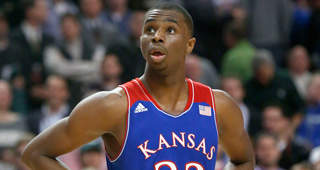
With the #1 high school recruit Andrew Wiggins in the fold, Kansas is once again the Big 12 favorite. Just look at the high school recruiting ranks of Kansas’ potential starting lineup:
PG Naadir Tharpe (RSCI #91 player in 2011)
SG Wayne Selden (ESPNU #14 in 2013)
SF Andrew Wiggins (ESPNU #1 in 2013)
PF Perry Ellis (RSCI #31 in 2012)
C Joel Embiid (up to #6 in ESPNU Top 100, though lower in other rankings).
Bench: Brannen Greene (ESPNU #47 in 2013), Conner Frankamp (ESPNU #46 in 2013), and Andrew White (RSCI #52 in 2012)
That’s a pretty special group of talent. But we need to be cautious before we label Kansas a Final Four favorite. This team is exceptionally young. None of these players have ever played more than 15 minutes per game at the college level.
And unlike Kentucky (where the recruiting class is filled with Top 10 recruits), many of these guys are more likely to produce down the road. Guys at Greene and Frankamp’s level of the rankings are more likely to become stars as sophomores or juniors than as freshmen. Embiid would appear to be a “sure thing” as a Top 10 recruit, but even the people who are raving about Embiid have described him as a raw talent. They expect him to blossom in 2014-2015, not dominate right away. When you add in the fact that PG Naadir Tharpe struggled with his shot last season, it is clear that Kansas doesn’t have the perfect lineup.
But it might be the perfect lineup for Andrew Wiggins. With so many young players, he will be the clear leader. Much like Texas with Kevin Durant, Kansas players will realize that the team can only achieve its lofty goals by getting Wiggins the ball. And he should be able to carry the team to another Big 12 title.
Of course, Kevin Durant lost in the second round of the NCAA tournament in 2007. And with its physical play, college basketball is not a sport that always showcases transcendent players. And after crunching the numbers, my model projects Kansas as the 8th best team in the nation.
Vegas will likely give Kansas better odds than what I have below. But Vegas is calculating the odds of winning a title. I am interested in measuring the quality over the full season, including November and December when Kansas’ young players will struggle with the adjustment to the college game. The model concludes that with Bill Self at the helm, Kansas will have an elite defense. He is the best in the business at getting new players to commit on that end of the court. But with so many young players, there will be offensive mistakes. Players will take bad shots. Players will commit silly turnovers. And the model projects Kansas’s offensive efficiency to be worse than some of the other elite teams.
My model’s revised Top 25 Standings look like this:
Pred Off, PredDef, PredPythag: The predicted points scored and allowed per 100 possessions, and predicted winning percentage against an average D1 team on a neutral floor.
Returning Minutes, Possessions: The loss of high possession players can be a larger detriment to the offense, thus I list percentage of returning possessions in addition to returning minutes.
T100: Number of players who were Top 100 recruits out of high school. People focus on Top 100 freshmen, but Top 100 players are also more likely to become breakout stars later in their career.
Last Pythag: Last year’s Pythagorean winning percentage according to Kenpom.com. This is essentially a measure of each team’s margin-of-victory in 2012-13.
Memphis continues to be one of the bigger movers in the rankings. When I first ran the projections model in early April, I assumed Memphis would have Tarik Black, Shaq Goodwin, and Top 40 recruits Austin Nichols and Kuran Iverson in the front-court. And the model projected Memphis at 16th nationally. But then Tarik Black transferred, and that had multiple consequences. First, Nichols and Iverson had slightly lower expectations than Black, who was an efficient player for three years with the Tigers. With Black gone, Nichols and Iverson would each have to play more minutes. And second, it became more likely that Memphis would have to give some backup front-court minutes to a player like HippolyteTsafack. Tsafack was not a Top 100 recruit out of high school and has had multiple knee injuries limiting him to less than 20 total games in his career. Both these factors lowered the projected offense and defense for the Tigers.
When I re-ran my model (without Black and Antonio Barton who also transferred,) Memphis fell to 29th. But when Memphis added George Washington forward and graduate school transfer David Pellom, the Tigers immediately upgraded their front-court depth and the model moved Memphis back up to 24th.
Meanwhile, guard Allerik Freeman was one of the only uncommitted Top 100 high school recruits at the end of April. He recently committed to Baylor. Baylor guard Deuce Bello (who struggled mightily last season posting an ORtg of 86) saw the writing on the wall with Freeman coming in, and elected to transfer. The upgrade from Bello to Freeman moved Baylor from 28th to 25th in my model. Even though the model remains skeptical of Baylor head coach Scott Drew, the Bears have reached the point where even an inconsistent coach should have Top 25 expectations.
In my initial Top 25 and post NBA early entry Top 25, I have profiled all of the other Top 25 teams, but I haven’t discussed Baylor yet, so allow me to do that here:
Baylor’s front court remains one of the strongest in the nation with Isaiah Austin and Cory Jefferson. But the team also welcomes back rising sophomore Ricardo Gathers who was seriously under-utilized last year and could easily become a star in his own right. And prized forward recruit Dominic Woodson should also provide solid post minutes off the bench.
The biggest question is the point guard position. And while no single player can replace Pierre Jackson, Baylor does have three fairly nice options. First, even though Gary Franklin hasn’t been efficient throughout his career, he was a Top 100 recruit out of high school and remains a high potential player. Second, JUCO transfer Kenny Chery should be steady, even if he doesn’t dominate. And third, Brady Heslip may be able to provide some minutes at the position. Heslip may not be able to create much, but paired with a player like Freeman in the back-court, he could certainly be counted on for basic ball-handling duties. Throw in prized recruit Ishmail Wainwright and the possible late development of LJ Rose (a highly ranked high school player who still has high potential), and the model can no longer keep Baylor out of the Top 25.
Moving Up
Recently VCU added Florida St. graduate transfer Terrance Shannon. Shannon was not super-efficient at FSU, but the step down in completion should help some. And he makes a difference for VCU because Jarred Guest and Justin Tuoyo were not impressive last year and may not be ready for expanded roles this season. Shannon can help stem the tide until those players improve offensively. In net, VCU improves from 24th to 21st with the addition of Shannon.
Pittsburgh also jumped up from 19th to 15th with the addition of Marshall graduate school transfer DeAndre Kane. Most college basketball experts have Pittsburgh much lower. In fact, I’ve seen experts write how Kane’s addition “could” make Pittsburgh an NCAA tournament team, suggesting they are closer to 45th in the nation than 15th. But the tempo free numbers love James Robinson, Lamar Patterson, JJ Moore, Top 100 recruit Mike Young, and Talib Zanna. And Kane’s efficiency should improve now that he will need to shoot less.
That said, I believe you can make a case that the tempo free numbers are wrong here. Kenpom.com may have had Pittsburgh 11th last season, but they only received an 8-seed in the NCAA tournament. And even though Pitt finished 12-6 in the Big East last year which made all of their numbers look good, they didn’t really beat quality teams late in the year to justify a strong seed. For example, Pitt’s big win at Georgetown which helped inflate their margin-of-victory numbers came early in the conference season before Georgetown figured out its offense. I understand why the numbers like Pitt at #14, but I also understandwhy most experts are skeptical of that rank.
The team that should have “could” make the tournament attached to it is Oregon. While adding graduate school transfer Mike Moser improves the Ducks expectations substantially, they still seem to be missing the pieces they need to be a winning team in the Pac-12. I will have more to say about Oregon and the Pac-12 in a future week.
While the NCAA Tournament has cachet all its own, one way of looking at the Tournament is through the lens of the NBA. While the lottery guys get plenty of buzz leading into the Tourney, I like to spend more time on the players on more middling teams for the first few days since it is less likely that their teams survive long enough to evaluate them further.
On that note, here is the day-by-day:
Saturday
Headline game(s):
Michigan vs. VCU (12:15 PM Eastern)- Trey Burke, Tim Hardaway Jr, and Glenn Robinson III battling Shaka Smart’s fit-inducing system makes this both the most watchable and the most interesting prospect game of Saturday.
Michigan State vs. Memphis (2:45 PM Eastern)- Gary Harris and Adreian Payne going against Memphis’ collection of high level athletes. DJ Stephens gets another chance to show what he can do after an eye-opening first round block party.
Other games to watch:
Gonzaga vs. Wichita State (8:40 PM Eastern)- Considering how well the Shockers played against Pitt, this one should be a tough test for Kelly Olynyk and the Zags.
Syracuse vs. Cal (9:40 PM Eastern)- The two main prospects in this game (Michael Carter-Williams for Syracuse and Allen Crabbe for Cal) will each have challenges on offense in this one. However, that should be exactly the right crucible to improve the draft stock if one or both of them can put together a good all-around game.
Sunday
Headline game:
Kansas vs. North Carolina (5:15 PM Eastern)- The game on the weekend with the most prospect star power. Ben McLemore and Jeff Withey (who had a very nice opening round) try to move on against the UNC talents. McLemore in particular will have a challenge because the Tar Heels have quality defensive talent on the perimeter that will make scoring more difficult than usual.
Other games to watch:
Indiana vs. Temple (2:45 PM Eastern)- Two of the only remaining top ten players left here (Zeller and Oladipo), which warrants inclusion on the list.
Miami vs. Illinois (8:40 PM Eastern)- One of the best Point Guard matchups of the entire Tournament as Brandon Paul and Shane Larkin go at it. Paul could not pick a better game to resuscitate his draft stock than this one.
Duke vs. Creighton (9:40 PM Eastern)- Plenty of potential NBA players in this one, especially after a nice little game from Doug McDermott on Friday. A nice showcase on offense and defense for Mason Plumlee, Ryan Kelly, and McDermott, three often-discussed players who still have to prove themselves in terms of the draft.
San Diego State vs. Florida Gulf Coast (7:10 PM Eastern)- Jamaal Franklin tries to do what Otto Porter and Georgetown could not: beat this year’s Giant Killers. FGCU’s surprising level of athletic talent will force the talented SG and who knows, potentially they have some underscouted NBA talent of their own…
The Pac-12 has been suffering through a long dark period. The Big Ten has been dominant (at least in the pre-conference schedule) for the last few years. Should we expect a change this year? Is the Pac-12’s slump over? Is the Big Ten’s boom about to come to an end? Let’s take a quick look at some basic roster data and see if we can uncover any trends.
Part of predicting the season is noting the number of elite high school prospects on each roster. Not only are these players more likely to play well as freshmen, but they are also more likely to breakout later in their career. Recall, for example, Michael Snaer of Florida St. Snaer was a former Top 20 recruit, and while it took him three seasons, he broke out in a big way in 2011-12. After adding up the numbers…
- The Big East has the most former RSCI Top 100 prospects on rosters heading into the season with 58.
- But the Big East has more teams, and the Big East has only 3.9 elite recruits per team. The ACC has the most former Top 100 recruits per team with 4.6 per team.
- But James McAdoo is the only former Top 10 prospect in the ACC this season. That seems like an unprecedented lack of super-elite talent for the conference. If you want super elite talent, you probably want to watch the SEC, assuming everyone is declared academically eligible. John Calipari never lets us down on the recruiting trail.
- The SEC, however, is only welcoming ten Top 100 freshmen this year as a whole. Even the Big Ten, the land of typically poor recruiting, is welcoming more Top 100 freshmen than the SEC this season. And yes, the slumping Pac-12 brings in quite a few elite recruits this year.
Conf
T10
T100
T100 Fr
ACC
1
55
22
BE
1
58
17
SEC
4
49
10
B10
1
40
15
B12
3
33
11
P12
3
37
15
MWC
1
15
5
A10
0
11
3
The next table isn’t really roster data, but it does reflect some of my preliminary projections about playing time.
- The ACC is going to be the youngest conference in the nation this year, according to my projections.
- The Big East has a startlingly low number of key seniors on rosters this year.
- As usual, the MWC and A10 have more mature rosters. They lose fewer players to the NBA and that helps the top MWC and A10 teams compete, even without a plethora of blue chip talent.
Class
Sr%
Jr%
So%
Fr%
MWC
35%
30%
17%
17%
A10
33%
27%
19%
21%
P12
28%
32%
18%
22%
B12
32%
19%
26%
23%
BE
22%
32%
27%
19%
B10
27%
26%
23%
24%
SEC
25%
28%
24%
22%
ACC
25%
22%
23%
31%
The Pac-12 is getting older in a hurry, thanks in no small part to an influx of transfers. Note that your transfer numbers may vary slightly. I’m excluding transfer walk-ons and a few JUCOs who seem unlikely to play in the next table.
Incoming Transfers
D1
JUCO+
P12
15
8
SEC
10
11
BE
14
6
MWC
7
5
B12
7
5
A10
8
3
ACC
3
3
B10
5
1
The transfer table doesn’t mean the Pac-12 has suddenly become the conference of transfers. This is all a natural consequence of recent league history. The Pac-12 teams have struggled the last few years making those teams particularly attractive places for transfers to matriculate. If you want to transfer and PLAY in an elite league, you would have chosen the Pac-12 too. On the other hand, the Big Ten has been on an upswing and few coaches have needed to dip into the JUCO ranks as a quick fix. Deverell Biggs of Nebraska is currently the only incoming JUCO player projected for the Big Ten this year.
Overall, the Pac-12 was a depleted league, but it is adding a number of impact freshmen and key transfers this year. The days of the league failing to field a Top 25 team are over. As for the Big Ten, the jury is still out. The teams at the top still have plenty of talent, but programs like Purdue could be in for a bit of a slip without an influx of can’t miss players coming in.
College sports programs belong to their fans while professional sports organizations belong to their owners. There a lot of things seriously wrong with the NCAA and its underlying business model, but the situation in the NBA is far, far worse.
Twelve of the 16 teams in the Sweet Sixteen were in the preseason AP Top 25, and Michigan St. was among the first teams in the “others receiving votes” category. But Indiana, Ohio, and NC State have all exceeded expectations this season by making it this far.
It was Kansas, Missouri and Baylor atop the Big 12 for a large part of the season, but Bill Self’s Jayhawks eventually pulled away as they have in each of the past eight campaigns.
Breaking down Duke/North Carolina, Syracuse/Georgetown, Kansas/Baylor and Florida/Kentucky, along with which conferences are improving with the new round of shuffling.
There are a lot of complicated ways to evaluate college coaches, but in this edition we look at the coaches with the best per possession numbers over the last five years.
Teams that play a lot of freshmen are the most likely to improve as the season goes on, while those with a lot of experience are more likely to plateau. In this piece, we examine freshmen minutes for every major school in the country.
Syracuse has yet to leave New York and have played a relatively soft schedule, with their only impressive wins coming against Florida and Stanford, but they are 10-0 and now No. 1 in RealGM’s weekly poll.