May 19, 2013 10:59 PM EDT 
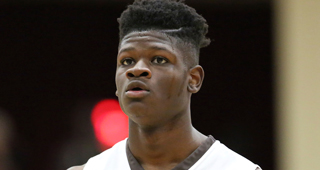
Kansas fans are still smiling about Andrew Wiggins’ decision to attend the school. In this edition, I explore how the rest of the Big 12 will look in 2012-13.
For a description of the model that generated these rankings click here.
|
Team
|
Proj CW
|
Proj CL
|
Proj Off
|
Proj Def
|
Last Off
|
Last Def
|
T100
|
Ret Min
|
Ret Poss
|
|
Kansas
|
14
|
4
|
113.6
|
89.2
|
111.8
|
85.7
|
8
|
23%
|
23%
|
|
Oklahoma St.
|
14
|
4
|
113.6
|
89.3
|
107.4
|
88.3
|
5
|
89%
|
93%
|
|
Baylor
|
12
|
6
|
115.3
|
95.1
|
114.2
|
94.5
|
7
|
60%
|
54%
|
|
Iowa St.
|
10
|
8
|
111.5
|
96.3
|
117.6
|
97.6
|
3
|
36%
|
37%
|
|
West Virginia
|
10
|
8
|
110.6
|
95.7
|
103.6
|
99.9
|
3
|
67%
|
62%
|
|
Texas
|
8
|
10
|
102.6
|
91.9
|
100.9
|
94.5
|
5
|
65%
|
59%
|
|
Kansas St.
|
8
|
10
|
104.0
|
94.2
|
113.0
|
94.5
|
0
|
49%
|
44%
|
|
Oklahoma
|
6
|
12
|
101.7
|
96.5
|
110.0
|
95.9
|
1
|
41%
|
37%
|
|
Texas Tech
|
5
|
13
|
102.7
|
101.2
|
96.7
|
105.4
|
0
|
77%
|
76%
|
|
TCU
|
3
|
15
|
95.6
|
99.4
|
91.6
|
102.2
|
1
|
44%
|
46%
|
For an explanation of column headings click here.
Kansas: As I noted on Twitter, if you think Kansas should have a better projection, you may be right. The historic data may not give us an accurate read on Andrew Wiggins. If he is the best high school prospect since LeBron James, that literally means there hasn’t been a comparable freshman in my data. On the other hand, if we can learn something from past freshman phenoms, the lesson is to be careful. In 2010, pundits everywhere claimed that Harrison Barnes was the No. 1 player in the country and one of the greatest prospects on the planet. Then Barnes had such a dreadful freshman season that he stuck around for his sophomore year. And even if Wiggins is great, on a young team with an entirely new starting lineup, there will likely be a few hiccups.
Oklahoma St.: You know your team is headed in the right direction when this is one of your top off-season questions:
Can JUCO center Gary Gaskins replace what Philip Jurick gave Oklahoma St. last year? Jurick wasn’t much of an offensive player, and he was in foul trouble way too often, but he did provide some nice size, shot-blocking, and rebounding when he was on the court.
Yes, the Cowboys return 93% of their offensive possessions on a team that almost won the Big 12 last season. With Markel Brown throwing down more windmill dunks, LeBryan Nash hopefully maturing into his high potential, Michael Cobbins continuing to dominate the paint, and All-American candidate Marcus Smart returning to school, the future is bright.
The only negative piece of news I can find is this. ESPN dropped recruit Detrick Mostella out of its Top 100. (I’m still counting him as a Top 100 recruit until the final consensus rankings are out.)
Baylor: I provided a more detailed summary of Baylor’s lineup last week, but here are a few more thoughts: Losing LJ Rose and Deuce Bello is not a big deal. They had ORtgs of 69 and 86 last year. In fact, Baylor actually moved up from 25th to 24th in my model with the announcement that Rose is gone. He won’t be wasting a handful of possessions in meaningless games this year. And with the recent news that Denver’s Royce O’Neale will be transferring to join the team, Baylor could move even higher. (I want to hear more confirmation that O’Neale will be eligible immediately before I move him into the lineup.)
Iowa St.: Fred Hoiberg just refuses to have a rebuilding year. He has added four JUCO players this off-season. By bringing in transfers three years in a row, he has ensured he has enough veterans to compete each season.
Part of me thinks this is because he is hoping to jump to the NBA. Hoiberg doesn’t want a down-season to wreck his reputation. But if the quick fixes keep working, it is hard to argue with the strategy.
The only real question mark is at PG where freshman Monte Morris has been rising up the recruiting ranks, but still isn’t high enough to be a guaranteed star. Still, with all those JUCO players supporting Georges Niang, Melvin Ejim, and Top 100 prospect Matt Thomas, this team should finish in the top half of the Big 12.
West Virginia: Right now I have West Virginia as the 45th best team in the nation, which would put them squarely on the bubble. But I have complete confidence that Bob Huggins will be back in the tournament. And it isn’t just based on his history of winning. The roster turnover for West Virginia is ideal. Deniz Kilicli, Jabarie Hinds, and Dominque Rutledge had ORtgs of 92, 86, and 84 last year. They were the three least efficient players in the West Virginia lineup. And their departure should hasten the improvement in the West Virginia offense.
I will never understand why Bob Huggins felt so compelled to build his offense around Kilicli. He may have been big and bearded, but he was a poor rebounder, poor finisher, and he had bad hands. Trusting Kilicli was one of Bob Huggins worst decisions at West Virginia.
But Huggins refuses to have another team that lacks interior strength. Huggins is bringing in Top 50 recruit Devin Williams in the paint, two JUCO paint players, and three more freshman forwards. The message is pretty simple. Bob Huggins is tired of his post-play being a liability.
Texas and Kansas St.: I stared at this for awhile, because it surprised me that Texas has a better defensive projection than Kansas St. The bottom line is that the teams had equivalent defenses last year, the coaches have almost identical historical defensive performance (Rick Barnes is seriously under-rated as a defensive coach), and thus it came down to two other factors. First, Texas has more Top 100 recruits. Having athletic players helps on defense as well as offense. Second, Texas returns a larger percentage of its rotation, which should help with continuity.
Still, I suspect Bruce Weber will do even better defensively than what you see here. And he’ll need to given what Kansas St. loses. The Wildcats return just 44 percent of their possessions from last season, and with no elite recruits coming in and no high potential players on the roster, the offense is simply going to take a huge step back.
The Kansas St. player most likely to break out is probably Thomas Gipson. He has been a relatively efficient aggressive player his whole career, and with more playing time, his PPG and RPG numbers should skyrocket.
Shane Southwell and Will Spradling are also quality players, but both have flags that make the model question whether they can become stars. For Southwell, there is a concern whether last year’s hot three point shooting will be sustainable. Southwell suddenly jumped from being a guy who couldn’t buy a three pointer to a 44 percent three point shooter last year, and there may be some regression. And Spradling was super-efficient, but rarely shot. It isn’t clear whether Spradling can maintain his efficiency while taking a larger role on the team.
But even if the Kansas St. offense falls off dramatically, the Texas offense still looks worse on paper. Returning Top 100 recruits Cameron Ridley, Prince Ibeh, Javan Felix, and Jonathan Holmes should make some progress. But even if they do, this still won’t be a good offensive team.
Oklahoma: The Big 12 is really becoming the land of JUCO transfers this year. When Amath M’Baye unexpectedly declared for the draft, Lon Kruger realized he would be starting over in the paint and brought in three JUCO big men to try to fill the void. But I’m surprised he didn’t bring in a JUCO transfer at the PG position. With Sam Grooms departing, there is a real empty spot at that position too. Isaiah Cousins has the highest assist rate of any returning guard, but he struggled with turnovers. And that probably means that unranked freshman Jordan Woodard will be asked to run the show. Without high potential players in the paint or at the PG spot, there just isn’t a lot of upside for this team. The model projects them to win five less conference games than a year ago.
Texas Tech: I stared at the Texas Tech projection for awhile because it really doesn’t make sense to me. Certainly, I expect Tubby Smith to turn Texas Tech’s defense around. For Texas Tech’s defense to improve to 102.7 seems like a cakewalk. But I was puzzled that the model is so optimistic about Texas Tech’s offense. Basically, this is a case of addition by subtraction. The only key player Texas Tech loses is Josh Gray.* And Gray used way too many possessions (15 of 80 from 3) for an inefficient player (81 ORtg) while running the point for the Red Raiders. Of course backup PG Daylen Robinson wasn’t any better (70 ORtg). And you can see why Tubby Smith’s first move at Texass Tech was to go sign a JUCO PG in Robert Turner. Turner may not have major upside, but his job should simply be to get the ball to the other players and stop wasting possessions. Jaye Crocket, Jordan Tolbert, Dejan Kravic, and Dusty Hannahs may not have been good players, but they were average. And just making sure the team gets an average shot each possession will be a serious upgrade from last season.
Of course, to some degree the model may be falling for the “bad shot fallacy.” I.e., when a team runs its offense and can’t get a good shot, the PG often ends up jacking up threes as the shot-clock expires. Josh Gray wasn’t the only bad player on the team last year. But with a new coach and most players back, some upward trajectory is certainly possible.
*Ty Nurse is also gone but he almost never shot the basketball.
TCU: It feels like TCU should be making a bigger move in the right direction. Kyan Anderson was a remarkably solid PG on a dreadful offensive team. Devonta Abron looks like he might be a legitimate Big 12 post player. Meanwhile transfer Karviar Shepherd is the first consensus Top 100 freshman to attend TCU since at least 2000. But TCU was an absolutely dreadful D1 team last year. And with only 44% of the teams minutes returning, the Horned Frogs will be breaking in a bunch of new unranked players again next year. When transfer Trey Ziegler joins the team in 2014-2015, there might be some real upward mobility. Until then expect more of the same.
Andrew Wiggins, Shane Southwell, Will Spradling, Thomas Gipson, Markel Brown, Marcus Smart, LeBryan Nash, Kansas Jayhawks, Oklahoma State Cowboys, Baylor Bears, Iowa State Cyclones, West Virginia Mountaineers, Texas Longhorns, Kansas State Wildcats, Oklahoma Sooners, Texas Tech Red Raiders, Texas Christian Frogs, Big 12 Conference, NCAA Mar 01, 2013 7:22 PM EST
Twenty years after the Dream Team, the 2012 edition brought the story of NBA players in the Olympics full circle with a dominating performance in London. Team USA had been embarrassed in international competitions from 2002-2006, but those losses were as much a story of American arrogance and indifference as they were the rest of the world catching up. Once Jerry Colangelo and Mike Krzyzewski modernized USA Basketball, the US went right back to its accustomed perch atop the world of basketball, going undefeated from 2008-2012. While there were NBA players on nearly every team in London, the critical mass of talent the Americans had on hand was overwhelming. No other country could afford to cut players with significant NBA experience; Team USA had their pick of All-Stars. Spain, the silver medal team in Beijing and London, might have been able to upset the US in a one-and-done scenario, but no one would have given them a chance in a best-of-seven series. Twenty years after Michael Jordan, Larry Bird and Magic Johnson brought basketball to the international stage, the Americans still don’t have a legitimate rival. That doesn’t appear likely to change in the short-term. With Argentina's “Golden Generation” on their last legs and the Gasol brothers creeping into their 30’s, no other country has a core of elite players in place to challenge Team USA by 2016. The renewed American dominance has prompted calls to tweak the Olympics to make them more competitive, from removing NBA players entirely to imposing an age limit, but that may prove unnecessary in the long-term. Canada, the only other country with an NBA franchise, has steadily developed a basketball culture over the last generation, the fruits of which are taking shape in college basketball this season. James Naismith is Canadian, but it took a long time for his native country to embrace the sport. The NBA didn’t expand into Canada until 1995 and no Canadian colleges play in the NCAA Tournament, so there was never a hometown team young athletes north of the US border could grow up rooting for. As a result, Steve Nash, the first great Canadian basketball player, never had a chance in international competitions, not with so little talent around him. The country has put others in the NBA -- Bill Wennington, Todd MacCulloch, Samuel Dalembert -- but the first noticeable wave of talent has emerged only in the last few years. In 2011, 16 years after the Toronto Raptors played their first game, two Canadian players were taken in the first round. Both Tristan Thompson and Cory Joseph benefitted from the sport’s broadened horizons, making a name for themselves in AAU competitions before eventually playing at Findlay Prep in Las Vegas and spending one year of college at Texas. Three more Canadians -- Andrew Nicholson, Robert Sacre and Kris Joseph -- were selected in 2012, although Nicholson, a promising young power forward for the Orlando Magic, is the only one certain to have a long NBA career. In 2013, the wave of Canadian talent became a flood. There’s quantity, with 90 Canadian players on a D1 scholarship, and quality in the form of three first-round prospects -- Anthony Bennett (UNLV), Kelly Olynk (Gonzaga) and Myck Kabongo (Texas). Behind them, Nick Stauskas (Michigan), Jordan Bachynski (Arizona State), Khem Birch (UNLV), Kevin Pangos (Gonzaga) and Kyle Wiltjer (Kentucky) are all on the radar of NBA scouts as well. Sim Bhullar (New Mexico State) is a 7’5 355 human being who can run up and down a court, so there might be a place for him at the next level down the road. Bennett is the unquestioned prize of this year’s crop. At 6’8 240 with long arms, a quick first step and great leaping ability, he’s the prototype small-ball power forward in the modern NBA. And while combo forwards who rely mainly on their athleticism have struggled to make the transition from college (Derrick Williams), Bennett is a surprisingly skilled player with a smooth jumper, deceptive ball-handling ability and great touch around the rim. He’s averaging 17 points and 8 rebounds game on 54/37/71 shooting as a freshman in the Mountain West, the second best conference in the country this season. He’ll need to improve his passing and defensive ability to be a legitimate franchise player on the next level, but he should be a borderline All-Star for the next decade regardless. Olynyk has been one of the most surprising players in the country this season. After redshirting last year behind a glut of NBA prospects at Gonzaga, he’s emerged as an All-American candidate as a junior. He’s always had a great outside shot for a 7’0 240 big man, but he’s developed the capability to put the ball on the floor, finish through contact and post up smaller players this season. Olynyk is the go-to-player on the No. 1 team in the country, averaging 17 points and 7 rebounds a game on 66/38/79 shooting this season. It’s unclear whether he’ll have the defensive chops to be a starter at the next level, but his ability to space the floor at his size will ensure that he has a long career in the NBA. Kabongo, thanks to an uneven freshman season and a capricious 23-game NCAA suspension to start his sophomore year, is still somewhat of an enigma after returning to action only two weeks ago. A 6’1 180 point guard with breathtaking speed and great floor vision, he’s been a highly touted prospect since his days at Findlay Prep. However, he still needs to answer questions about his perimeter jumper and decision-making ability before an NBA team will be willing to give him the keys to the offense. After what he went through this season, it would be hard to blame him if he declared for the draft, but he’s likely to spend the first few years of his pro career like Joseph -- riding the end of the bench and shuttling back and forth to the D-League -- if he is taken at the back of the first round in 2013. Looming over all of them is Andrew Wiggins, the No. 1 player in the class of 2013. There’s never been an international prospect like Wiggins, an athletic 6’7 205 wing who can beat American players at their own game. His ongoing recruitment has been one of the biggest stories of the college basketball season, while NBA teams are already dreaming about taking him with the No. 1 overall pick in 2014. It’s still way too early to know whether whether he can live up to the hype surrounding him, but if he can, he will be surrounded by a lot of talent on the Canadian national team. By 2020, Canada could have a team with Olynyk, Thompson and Nicholson upfront, Wiggins and Bennett on the wings and Kabongo running point. Even if some of them don’t pan out, with so much interest in basketball in Canada, the country’s pipeline of talent won’t run out as abruptly as it did in Argentina. There’s already one Canadian, a 6’8 210 forward named Trey Lyles, among the top players in the class of 2014. For all of them, the biggest game of their careers may end up being a match-up with Team USA in the 2020 gold medal game. The future of basketball, both in Canada and around the world, is bright indeed.
Dec 10, 2012 7:58 PM EST Final exams are here in college basketball, making this the quiet period of the season. After the excitement of the Champions Classic, the Holiday Tournaments, and the ACC/Big Ten Challenge, college basketball must make it through a relatively boring stretch on the schedule.
The marquee game last week was supposed to be UCLA taking on Texas at Reliant Stadium in Houston. But with UCLA losing a bunch of early games (including blowing an 18-point lead against Cal Poly), and with Texas struggling (including a loss to Chaminade in Maui), this game had lost most of its luster. In fact, it lost so much luster, that less than 3000 fans showed up to watch a game being played in a dome stadium.
Fittingly, the game lived up to its billing. Texas turned the ball over possession after possession down the stretch allowing UCLA to come from behind at the end. But UCLA couldn’t make free throws that would seal the game. Then Texas air-balled a three at the buzzer that would have won the game. UCLA prevailed, but neither team was able to shake its reputation as a disappointment early in the year.
(Quick side note about Texas. The Longhorns' defense has actually been shockingly good this season. No team has a better eFG% defense at this point in the season than Texas, meaning the Longhorns are forcing teams to miss both their twos and threes at an impressive rate. Rick Barnes simply doesn’t get enough credit for his ability to teach defense. Unfortunately, without point guard Myck Kabongo, Texas’ offense has been dreadful. Only Sheldan McClellan and Julien Lewis have shown a consistent ability to put the ball in the basket this year, and the Longhorns other four Top 100 prospects out of high school have been nothing short of horrible, sporting ORtgs of 61 to 83. No team can win consistently when only two players have ORtgs over 100.)
But the beauty of college basketball is that even on a weekend with few marquee games, the plethora of games ensures there are always some fantastic finishes:
- UNLV’s Quintrell Thomas caught the ball under the basket and put back in a lay-up that gave UNLV a last-second win against California. Both teams will be likely be in the NCAA tournament this year, so it was an important win for both UNLV and the MWC. UNLV’s Mike Moser injured his elbow in the game, and that bears watching.
- Elsewhere, West Virginia handed Virginia Tech their first loss of the season on a Juwan Staten lay-up in the final seconds. West Virginia had high hopes for the elite transfer Staten, but his debut was an ugly 0-6 two turnover performance against Gonzaga. Fortunately Staten had bounced back, scoring in double figures the last four games and living at the free throw line. And against Virginia Tech, Staten drove the lane in the final seconds and hit a lay-up that proved to be the game-winner.
- Meanwhile, Purdue and Mississippi were reminded why major conference teams hate to play at mid-major venues. Purdue fell 47-44 at Eastern Michigan. This is not a great Eastern Michigan team, but with Eastern Michigan turning the ball over only four times, while Purdue turned the ball over 18 times, those 14 additional possessions made all the difference in the upset win. Meanwhile, Middle Tennessee’s Kerry Hammonds made a jumper in the final minute to break a tie and give Ole Miss its first loss of the season. Unlike Eastern Michigan, Middle Tennessee has been playing pretty good basketball this season, and this loss might not hurt quite so much come selection Sunday.
Other notes
- Illinois was back to making three-pointers in Saturday’s win over Gonzaga, sinking 11 in the win. With over 10 made threes per game, I am very curious whether this will continue in conference play.
- Last season, Florida St. had a scatterbrained resume of puzzling losses to bad teams and amazing wins against Top 10 teams. It was largely because of their one-sided play. When you play elite defense, all you need is for a few surprising shots to fall and you can beat an elite team. And when you have lousy offense, all you need is for your opponent to hit a few surprising shots and you can lose to anyone. Georgetown looks like that team this year. They lost to Indiana in OT and have thus far pulled out close wins against teams like Towson. Still, the Hoyas have some head-scratching games ahead, given their great defense and poor offense.
-Michigan’s Nik Stauskas continues to be way more athletic than I anticipated. When the Arkansas game tightened up near the 12 minute market of the second half, Stauskas had the ball at the wing and I thought a turnover was coming. Instead he shook his man, drove all the way to the edge of the free throw line, and banked home a long-layup. To me, it was a game-changing play.
Of course, I have already learned to love Illinois’ three-point shooting, Stauskas’s game, and Georgetown’s defense. In fact, I wonder if sometimes the computers learn more from these December games than the media. We all know that Kansas is going to be the favorite in the Big 12 in conference play, and that Bill Self’s teams play lock down defense year-after-year. But with ugly games against teams like Chattanooga and San Jose St., Kansas was no longer looking like a Top 10 team in most computer rankings. That changed on Saturday with the Jayhawks 36 point thrashing of a solid Colorado team. I tend to struggle with what to say about a 36 point loss, but in the grand scheme of ranking teams, all these games provide important information.
The other takeaway from the Colorado-Kansas game is that regional rivalries don’t have to die when teams switch conferences. Missouri and Kansas might not play again, but if they do not, that is a dumb choice by the teams. It is not a necessity.
Undefeated but Overrated
As the number of undefeated teams dwindles (we are down to 14 after Sunday), columnists tend to write about which teams with strong starts are over-rated. But I hate that tone. Nobody honestly believes that Charlotte is an elite team after a 9-0 start. But why rain on the parade of a team that has exceeded expectations.
It is one thing to say that you don’t necessarily expect a team to keep it up. If a team is winning close games, it is reasonable to ask whether they will still have a strong season in conference play.
It is one thing to criticize strength-of-schedule and say you wish that an elite team had played more quality competition. For example, I wish Arizona would have scheduled a few more marquee games, because until they play Florida next weekend, I still have no feel for how good this team can be.
But I hate it when people criticize a team for doing what they are supposed to do and winning games. Wyoming is my favorite example. Larry Shyatt had a disappointing run as Clemson’s head coach, but after joining Billy Donovan’s staff and helping Florida win two national championships, he finally got a second chance with the Cowboys. In his first season, he completely turned Wyoming’s team around by emphasizing defense, and now in his second season, his team’s offense is starting to come around. Wyoming isn’t an elite team, but after they came from 18 down to beat Illinois St. and preserve their undefeated mark, they deserve praise, not criticism for an undefeated start.
Do December games matter if everyone is focused on the NFL?
The NBA wants you to think its regular season is extremely important. But when San Antonio can choose to rest four key players at the Miami Heat, that undermines the NBA’s credibility. Chuck Klosterman wrote a fantastic piece recently asking some key questions about whether San Antonio owed it to NBA fans to play its star players against the Heat.
The beauty of college basketball is you never have to ask those questions.
- Almost every player is young, and even with some teams now playing 40 games, the season is still relatively short. The number of key players debating whether to play through a nagging injury is relatively small.
- For most of these kids, this is the moment. Was Louisville’s Peyton Siva really going to complain about playing three games in three days in the Bahamas and not want to give it his all against Duke? Of course not. This season is his moment in the sun and he wants to take full advantage of it.
-Every game matters for selection Sunday. I’ve long said that there is no resting your starters in college basketball because nothing is ever clinched. With so many teams with similar resumes at the end of the year, every loss counts for seeding. In the NBA, if San Antonio drops a game against New Orleans in November, it probably won’t matter much to the team’s ultimate probability of winning a championship. But if UCLA drops a game to Cal Poly in November, it is a critical red-mark on the Bruins resume, and it might be the reason the Bruins don’t play in the regional round in Los Angeles in the Staples Center in March.
The Dreaded Early RPI
Even if the loss to Middle Tennessee (discussed above) doesn’t cost Ole Miss an NCAA tournament spot, the sum total of these wins and losses does matter for the conferences. And at this point, the SEC might have needed that win more than Ole Miss.
Through Saturday, the conference RPI standings were as follows:
|
1
|
Big Ten
|
|
2
|
Pac-12
|
|
3
|
Big East
|
|
4
|
ACC
|
|
5
|
MWC
|
|
6
|
A10
|
|
7
|
Big 12
|
|
8
|
SEC
|
|
9
|
MVC
|
|
10
|
WCC
|
At this point the SEC is sitting 8th among all conferences in terms of RPI rankings, and the plethora of bad losses by teams at the bottom of the conference is going to make it hard to earn quality wins in SEC play this year. And as bad a measure of team quality as the RPI may be, it is still a very strong predictor of NCAA selection.
Rob Dauster noticed it earlier this week, but even if the Pac-12 has lacked signature wins in the early season, because its teams are chalking up fewer head-scratching losses this preseason, winning Pac-12 games will mean something this year. Right now it looks like a team that goes 11-7 in Pac-12 will be in the discussion for an at-large bid, something you couldn’t say last season.
The bigger concern might be how many teams can make the tournament out of the Big 12. I thought the Big 12 might be the deepest conference in the country this year, but none of the Big 12’s bubble teams have been coming through. Kansas St., Iowa St., and West Virginia certainly don’t look like terrible teams based on their margin-of-victory so far this season, and Texas probably won’t be a terrible team in January and February (assuming Kabongo plays eventually). But none of those teams have done anything in their marquee games. The Big 12 might have eight legitimate teams eventually, but unless the conference has a stellar last few weeks of non-conference action, the league may be capped at four or five NCAA bids.
Texas Longhorns, UCLA Bruins, UNLV Runnin' Rebels, West Virginia Mountaineers, Virginia Tech Hokies, Purdue Boilermakers, Eastern Michigan Eagles, Illinois Fighting Illini, Florida State Seminoles, Michigan Wolverines, NCAA Dec 03, 2012 On Nerlens Noel, Isaiah Austin, Kyle Anderson and the rest of the freshman class as they play such prominent roles to begin the 12-13 NCAA season. Nov 20, 2012 On the reality of Maryland's move to the Big Ten and the greatness of the early season tournaments. Oct 08, 2012 The Legends Classic might be the most highly anticipated early season tournament because of the potential finals matchup between Indiana and UCLA. We also look at the CBE Classic, Maui Invitational, Cancun Challenge, Great Alaska Shootout, Battle 4 Atlantis and the Old Spice Classic. Mar 29, 2012 Shabazz Muhammad deservedly won the MVP award, but Alex Poythress had the most surprisingly outstanding game. How did the other players distinguish themselves? Mar 17, 2012 A running diary of a historic day in the NCAA tournament. Mar 12, 2012 Which teams have the best and worst performance against other NCAA tournament teams? And which teams have the best and worst performance in the last 10 games? Mar 12, 2012 A few preliminary thoughts on matchups and which teams will advance deep in the tournament. Mar 09, 2012 While personnel determine scheme in the NBA, college basketball coaches recruit players that fit their schemes. Feb 27, 2012 As Draymond Green locked up the Big Ten POY award and Kansas battled Missouri for a likely No. 1 seed, Saturday afternoon encapsulated everything that is great about the NCAA regular season. Feb 23, 2012 The best way to examine the value of specific college coaches is to examine how well they recruit and subsequently develop their talent. Let's examine the top 49 coaches from the Power 6 conferences. Jan 23, 2012 On a great weekend of college basketball that saw Florida State beat Duke at Cameron, Syracuse get their first loss, Kansas stave off Texas, as well as the reasoning why we must look at match-ups and reevaluations. Jan 02, 2012 Separating the BCS schools into tiers named after John Wooden, Dean Smith, Gene Keady, Rollie Massimino, John Chaney, Kelvin Sampson, Tim Welsh, Pat Knight and Sidney Lowe, how does everyone stand? Dec 26, 2011 Duke, Kentucky, UCLA, Texas, Kansas, North Carolina, UConn, Florida and Arizona each begin the 11-12 NBA season with 10 or more players on NBA rosters. Nov 10, 2011 There are many ways to build a winning program. John Calipari’s focus on younger players may be the best way to get elite recruits, but it isn’t the only way to build a winning program. Nov 05, 2011 Don't wait until March to start printing out college basketball brackets. With the Preseason NIT, Maui Invitational, Puerto Rico Tipoff and other excellent tournaments, you can start the madness in November. Oct 14, 2011 The value of transfers to BCS schools, plus why Baylor could have a top-10 team (if Bill Self was their coach instead of Scott Drew). Sep 28, 2011 Butler and George Mason have proven it is possible to reach the Final Four without Top-100 recruits, but Florida's success without Top-10 players in 2006 and 2007 may give us the most realistic scenario of success. Older Articles » |
|
Basketball Wiretap Headlines
|