yardbarker
RealGM Basketball

Basketball Articles

The Art Of The Managed Blow-Up

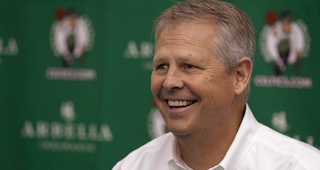
As the Boston Celtics hobble into the All-Star break, the fan base and media covering the team are obsessed with one issue: when and how should Danny Ainge commence the rebuilding operation. It is now clear that the Celtics have almost no chance of winning the 2012 NBA title, unless the basketball world spins off its axis entirely. The Celtics are more likely to win a playoff game or two than an entire series.

That Ainge has been looking to this day has been apparent by his refusal for years now to extend contracts past the 11-12 season, with the exception of Rajon Rondo and Paul Pierce. Even if Ainge stands pat, the Celtics will have room under the cap for a max-contract player. The problem is that of the two possible max contract players available—Dwight Howard and Deron Williams—neither has given the slightest indication that Boston is an option.

The question now is whether Ainge should expedite the process and cash in his aging chips for assets while he still can. This is difficult for fans and the team management because of the strong emotional attachment to the existing stars, who were the foundation of the 2008 championship team: Kevin Garnett, Ray Allen and, especially, Paul Pierce. If Ainge is going to deal these guys, especially Pierce, he can’t do it for a bag of dirty laundry.

In a fair world, these guys would all retire as Celtics. But the way the NBA works, if the Celtics follow that path, they increase the chances that the next decade will reprise 1993-2007. And that should greatly scare everyone who follows the Celtics.

By the March 15th trade deadline, we will know whether Ainge has decided to expedite the process. As emotionally painful as it will be in the near term, I think a case can be made that it is the best option if the Celtics want to return to contender status this decade.

This is Why You Do It

An NBA team “blows it up” when it no longer has a reasonable chance to contend, and when with every passing day it is clear the team is going to get worse before it gets better. An NBA team needs at least one top-10 player to be a legitimate contender, and usually two top-end players. That does not guarantee contention or titles; it is just the ante for admission.

Most NBA teams exist in purgatory—they do not have the necessary superstars to contend but they have neither the top draft picks or cap space to put themselves in position to get such a superstar or superstars, who are hard to come by under any circumstances. There is tremendous gravitational pull to keep mediocre NBA teams in this status. To be blunt, barring a number of injuries, there are only a handful of teams that have much of a shot at the 2012 title—Miami, Chicago, Oklahoma City and maybe two or three others. That is the general state of affairs in the NBA.

Really stupid teams in the circumstances of the present Celtics have traded away future No. 1 picks and signed mediocre guys to long-term deals in the long-shot hope that they might squeeze contention out of as team. It almost never works and only puts the team that much deeper in a hole. Danny Ainge, wisely, has studiously avoided that course. He knows the situation.

The Celtics throughout their history under Red Auerbach were always working to get superstars. The way Auerbach got players like Bill Russell, John Havlicek, Dave Cowens and Larry Bird was the work of genius. His last masterpiece was Len Bias.

The Celtics had a terrible interregnum from the early 1990s to 2007. That is the status quo for many NBA teams, and something along those lines will likely be the Celtics future unless the team gets lucky. Danny Ainge’s job is to put the team in the best possible position to get lucky. 

Right now, looking at the NBA landscape, it is considerably easier to make a case that the Celtics will be the doormats of the NBA for the balance of this decade than that they will again be legitimate contenders. There are some high peaks in the NBA range—Miami, Chicago, Oklahoma City, the Clippers—far beyond the Celtics at present course. Even the middle-range peaks look awfully high from the valley in our immediate future. Ainge is facing a high degree of difficulty. 

This is How You Do It

There are three iron laws for putting yourself in position to get lucky.

First, accumulate No. 1 picks.

Second, do not waste capspace.

Third, do not fear being very bad for as long as it takes. No. 3 has the added advantage of making the No. 1 draft pick much higher than it might be otherwise. It has nothing to do with “tanking.” Guys are playing as hard as they can; they just aren’t that good, because the team’s focus is on the future, not the present.

The downside to all of this is that even a team that scrupulously follows these rules may never succeed. That can be a career-ending recipe for a GM as fans tire of a very bad team with no apparent future after a few seasons. It takes courage, vision and a degree of luck. And it takes fans with vision and an understanding of the process. The Celtics have such fans, if they sense the management knows what it is doing. See the tremendous fan support the Celtics lottery teams of 2006 and 2007 received; fans sensed the team was building to something and they were paid off royally.

So what should Ainge do now?

There are three players who deserve serious consideration for being traded. Two of them will be free agents after the season, and their market value will disappear. The other’s market value will only decline after March 15. The point is to trade them to get future No. 1 picks, promising young players and contracts that expire so as not to tie up cap space.

First: Kevin Garnett. He is in the last year of a deal at around $21 million. Garnett would be a wonderful addition to a team that is in contention. He is a still a tremendous defensive player and a very solid NBA power forward. But the salary is an absolute killer for making a trade work, unless the Celtics are willing to back bad contracts. Even then it is difficult to find much of a deal.

Conclusion: The only deal I see that makes sense for both teams would be to trade Garnett to Cleveland for Antawn Jamison and Cleveland’s top-7 protected No. 1 pick, beginning in 2013. Why does Cleveland do it? They are fighting for a playoff spot, and putting KG next to Varejao would give them a monster interior defense. This could be a team that could make sparks fly. Byron Scott would go nuts to have this defense. A nice way to say thanks to their fans, who have suffered over the past two years. The cost is not that high, and does not hurt their cap situation. If it works out, the Cavs try to keep Garnett around for a couple more years.

Why do the Celtics do it? A 2013 No. 1 pick, and Jamison comes of the books after the 2012 season.

Second: Ray Allen. Ray is 36 and in the last year of his deal at $10 million, His defense has slid but he remains an exceptional three-point shooter, with the highest percentage of his storied career. There is likely interest in him from a team, and the Celtics ought to be able to find a deal that does not require the team taking back much salary past 2012 and that includes a future No. 1 pick. It will not be a lottery pick. Teams that jump out as possible candidates are Minnesota, Utah, the Clippers and Milwaukee.

Conclusion: The team that strikes me as the best bet is Minnesota, which desperately needs an off guard who can shoot, and a classy professional workaholic veteran to put next to their kids. Minnesota can offer expiring deals (or deals unguaranteed past 2012) like Brad Miller and Martell Webster. The Wolves can offer Utah’s protected No. 1 pick beginning in 2012. If the Celtics have not been conveyed Utah’s pick by 2014, the team gets Minnesota’s 2014 No. 1 pick.

Why do the C’s do it? A future No. 1 pick.

Third: Paul Pierce. Paul has one more guaranteed year after this season and an unguaranteed (or partially guaranteed) year in 13-14. If the Celtics do go into blow-up mode the team might even consider amnestying Pierce after the season, so he is definitely someone who should be on the market. He also still has big-time game, and is a legitimate All-Star. Pierce makes $15 million so he is a bit harder to move, but it is possible. Minnesota and Houston jump out as teams that could use him; the Lakers too.

Conclusion: Houston is the best possible partner. The Rockets are playing surprisingly well and need a small forward with Pierce's skill-set. With a player like Pierce, the Rockets could move into the first tier in the Western Conference and make it to the Conference Finals. The Rockets have a ton of expiring deals for guys who are not in the rotation and a GM in Daryl Morey who like Ainge is unafraid to shake things up. The Rockets also have the Knicks 2012 No. 1 pick. The deal for Pierce works if Houston gives up Hasheem Thabeet, Jonny Flynn, Terrence Williams, Chandler Parsons, Chase Budinger and the Knicks No. 1 pick. The Rockets are not giving up much, except their ability to compete in the free agent market in the summer of 2012. That did not look very promising for the Rockets, so they take Pierce instead.

Why do the Celtics do it? Clear massive additional cap space in the summer of 2012, so the Celtics could sign two max-contract players. (Are you listening Dwight and Deron?) The Celtics also get a mid-range 2012 no. 1 pick and two serviceable young rotation caliber 3s in Parsons and Budinger.

After the Hurricane

If the Celtics pulled the trigger on these three deals, what would it mean for the balance of the 2012 season?

Here is the roster:

5—O’Neal, Stiemsma, Thabeet, B. Miller

4—Jamison, Bass, JJJ, Wilcox

3—T. Williams, Parsons, Budinger, Daniels, Pavlovic

2—Pietrus, Moore, Webster

1—Rondo, Bradley, Dooling, Flynn

That is 20 guys, so five players would need to be waived. Looking at these names, that does not seem like a difficult operation.

This team would likely not make the playoffs and pick between seven and ten in the first round. It probably will not be pretty.

When the dust clears, this would be the situation of the team going forward:

5—Stiemsma

4—JJJ, possibly Bass (he has a player option for 2012-13)

3—Parsons, Budinger

2—Bradley, Moore

1—Rondo

So the Celtics have a core of seven or eight players, and, to be blunt, aside from Rondo, it is not especially impressive. It is possible that Thabeet, Flynn or T. Williams might show enough to warrant a small one or two year contract. At any rate this is a team that barring a major infusion of talent is aimed at the lottery in 2013.

On the other hand, Ainge’s pile of chips will have increased.

Future draft choices:

2012:

            Boston No. 1

            New York No. 1

            Clippers No. 1

            Boston No. 2

            (Possible Utah No. 1, but more likely in 2013 when it is top-12 protected, or 2014 when it is top-9 protected)

(Possible Milwaukee no. 2 if Bucks are not a lottery team, so unlikely)

2013:

            Boston No. 1

            Cleveland No. 1

            Utah No. 1 (may turn into Utah or Minnesota no. 1 in 2014)

            Minnesota No. 2

            Boston No. 2

It is crucial to remember that these No. 1 picks are as valuable as trading chips as much as they are for the purposes of drafting players. And talented young players can be parlayed into deals for superstars. Recall that Danny effectively converted Al Jefferson, Delonte West, Gerald Green, Sebastian Telfair and Ryan Gomes plus a couple of no. 1 picks into Ray Allen and Kevin Garnett in the summer of 2007.

The other huge asset that is built up is capspace, oodles of it.

In the all-time dream scenario, the Celtics have a killer draft in 2012. Then Ainge convinces Howard and Williams to join the team for max deals, and he uses the two newly created $2.5 million exceptions for Garnett and Ray Allen. Then the Celtics are back on top for the rest of the decade.

But that almost certainly will not happen. What to do with the capspace then? The new CBA requires team to spend a certain percentage of the cap amount every season so teams cannot hoard capspace. But what Ainge can do is simply sign players to one-year deal. Or, better yet, he can take players off of teams that need to shed salary to avoid the luxury tax or to clear capspace for free agents. If Ainge does this he gets a No. 1 pick in exchange.

The Celtics will likely have a high draft pick in 2013, and maybe 2014. But, if Ainge drafts with his usual skill, it will be a team chock full of exciting young prospects. The future will begin to look a lot brighter quickly and the trip to the very bottom will have been brief. But there is still no guarantee this returns the Celtics to legitimate contention; it only increases the odds sharply.

The point of this exercise is not to say that these are the very best deals; it is simply to demonstrate the types of options Danny Ainge has as he looks toward the immediate and long-run future of the team. The sad truth is that it is very difficult to get a superstar and contend in the NBA. Unless a team gets lucky it likely will not happen. What a well-managed blow-up does is increase the ability to get lucky. But the sad truth is that it is anything but a sure thing.

Is Doing Nothing Really an Option?

Finally, I have sympathy for those who detest the idea of breaking up the big three, especially Paul Pierce, and “tanking” in the immediate future. Until a few weeks ago, I was doing everything in my power to remain in your ranks. I love this team and these players and I take no pleasure in writing these words. But consider this: In two months the season will be over. We will have seen flashes of lovely basketball and periods that will be deplorable. The team will likely finish in the seventh or eighth seed and get promptly eliminated by Miami or Chicago. And those may be our last playoff memories for some time. The Celtics will have the 15th or 16th pick in the draft, and the Clippers, probably around 24th or 25th.

Then comes the offseason, when many of the current players, including Ray Allen and Garnett, will be unrestricted free agents. What point will there be for Allen or Garnett to return? They can then sign with legitimate contenders at optimum salaries. And why would the rebuilding Celtics bring them back, unless the miracle of miracles happens and Dwight Howard comes to Boston as a free agent. Ainge is certainly NOT going to squander capspace and draft picks on short-term fixes to make Garnett and Allen happy so the team can finish 43-39 and get the eighth seed in 2013.

Then what happens if the Cs enter 2012-13 with Paul Pierce, Rajon Rondo, a bunch of kids and a handful of Dooling-type journeymen to round out the roster? It will be a team certainly headed to the lottery, but with a grumpy disposition. Paul will be 35; he does not want to go through yet another rebuild. He wants to win and win now. The karma around the team will be sour and there will be pressure on Danny to get some veterans so we can make the 8th seed again and have the much-vaunted “puncher’s chance.” Danny will be doing Paul Pierce and the Cs no favors by keeping him around just to provide a memory of better times. It could become a nightmare.

All it will do, to be blunt, is postpone and make more difficult the rebuilding process. It is hard enough to build a legitimate contender under the best of circumstances. There is no reason to increase the odds. Best to start it right now, assuming deals along the lines I suggest are indeed plausible. 

Danny Ainge And The Art Of The Rebuild

As the Boston Celtics struggle this season, it is evident that this team is no longer a legitimate contender for the NBA title. It is also evident that the team is not merely a tweak away from returning to contention in the near-term. The Big Four boat is getting further from shore with every passing day, and the Celtics need a complete overhaul before there will be any hope for basketball in June, or maybe even May.

The question that is on everyone’s mind, including team president Danny Ainge, is what's next? What can the Celtics do to return to contender status? The long interregnum from 1993 to 2007 weighs like a nightmare in everyone’s minds. What, if anything, can be done to prevent a repeat of that painful experience? This article will answer these questions and provide context for understanding Ainge's options.

The Celtics are entering an absolutely critical juncture, and how Ainge plays his cards over the next year or two, and possibly between now and March 15, could go a long way toward determining whether the Celtics are about to enter a prolonged era of mediocrity a la 1993-2007—which is the status quo for most NBA teams—or whether they can hit the trampoline and regroup as a legitimate contender within three or four years.

******

There are two and only two states for an NBA franchise: you are either a legitimate contender or you are attempting to become a legitimate contender. The difference is night and day. The main criteria for assuming contender status is having a top-10 player on your roster, and ideally a top-5 player. Unless you have a top-10 player you are almost certainly not a legitimate contender. The teams that are the most serious contenders tend to be teams with two top-10 players, or one top-five player and two or three players who are in the top-30. 

Having such players does not guarantee a title, only contention, It is the ante for admission to contender status.

In the past 56 NBA seasons, only a few teams that won titles did not meet these criteria. (For a long detailed discussion of this, go to here and here) Over two-thirds of the 56 titles have gone to teams headed by just nine superstars: Bill Russell, Wilt Chamberlain, Larry Bird, Michael Jordan, Magic Johnson, Hakeem Olajuwon, Tim Duncan, Shaquille O'Neal and Kobe Bryant.

(Dallas, ironically, was very much a borderline champion, depending upon how one ranks Dirk Nowitzki at this stage of his career. Don’t bet on Dallas in 2012.)

Basketball is different than baseball and football in this regard. In those sports teams with the very best players can never win titles; ask Barry Sanders or Barry Bonds how many rings they have. In those sports teams can gradually improve and move to contender status by adding several good players and getting experience. The line between legitimate contention and non-contention is very fuzzy. 

Not so in the NBA. To think you can win titles by playing that incremental game and bypass having a top-10 player is fool’s gold. NBA history is littered with excellent teams like the 70s Chicago Bulls, 80s Milwaukee Bucks and 90s Indiana Pacers that won 50-60 games many times but, with the exception of the 2000 Pacers, never got to the NBA Finals, not to mention won a title. They lacked the necessary superstar. It is why current teams like the Hawks, Sixers, Jazz and Pacers may possibly have superb regular season records, but almost certainly will not win the NBA title. 

By this logic, the legitimate contenders for the 2012 NBA title are, in alphabetical order, Chicago, L.A. Lakers, Miami, Oklahoma City. Those should be the “final four” teams barring injuries. Orlando and the Clippers are in the hunt, but longshots. Everyone else is a non-contender, though a few teams like San Antonio and Dallas and the Knicks are close enough to the border to possibly delude themselves, and there is a slim chance they could get hot exactly as one of these other teams implodes. But don’t bet on it. 

In sum, it is a superstar-driven league. A good 22-25 of the 30 NBA teams never have a prayer every season because they do not have a superstar, or because the superstar they have is too young or too old or too injured.

***** 

This is the necessary context to understand the current options facing Danny Ainge, the Celtics’ Majordomo. The current Big Four Era has produced scintillating basketball, one NBA title in 2008, and nearly a second title in 2010. The straw that has stirred the drink has been Kevin Garnett, arguably the greatest defensive player of the last 15 years. Garnett could not do it alone and in Paul Pierce, Ray Allen and Rajon Rondo he had a magnificent supporting cast of top-30 All-Star caliber players. At its best, this was a team that could stay on the floor with any team that has ever played the game, if only because of its stellar defense.

Tragically, a 2009 knee injury when Garnett was 32, has contributed to his game deteriorating at a more rapid rate than most superstars of his caliber and abilities would have experienced. He is no longer an All-Star caliber player, not to mention a top-5 or top-10 player. The 2011 playoffs, when the Celtics were summarily dismissed by the Heat, was a last hurrah for this glorious team.

The hope that I held, and I suspect Danny Ainge and Doc Rivers held, was that Rajon Rondo would emerge as a top-10 player and prove himself capable of being the best player on an NBA contender. (My discussion of Rondo can be found here and here and here.) Were that the case, the Celtics would not need to engage in a rebuild as much as a reload. Rather than requiring the acquisition of a top-10 talent, Danny could focus on corralling two or three top-30 type players and be off to the races for the rest of the decade. No need to taste the lottery, or at least the deep lottery.

To even consider Rondo in such a light is remarkable. Nearly every top-7 superstar in NBA history has established himself as a first-team All-NBA, MVP candidate by the time he is 23. That certainly applies to the top seven superstars in the game today: LeBron James, Dwyane Wade, Dwight Howard, Derrick Rose, Kevin Durant, Chris Paul and Kobe Bryant. Rondo was nowhere near that at 23 or 24 or even today as he approaches his 26th birthday.

So how could anyone ever consider Rondo a candidate for top-10 status? As Bob Ryan put it, Rondo’s game is sui generis. When he is on his game, relentlessly attacking the rim, drawing fouls, commanding the offense with unrivalled vision, skill, and panache, and being the most disruptive defensive guard of this generation, Rondo is as good as any player in the game. America had the privilege of seeing that Rondo numerous times in the playoffs over the past four seasons, when he cranked out insane triple doubles. But, alas, that Rondo only appears occasionally, perhaps because his body cannot stand the wear and tear of such a physical game. Most of the time Rondo is far less aggressive offensively, and is a top-25 player, not a top-10 player. And that is all the difference in the world when it comes to having a contender.

Bottom line: Rondo can be a magnificent #2 guy on a championship contender, but if he is the best player on your team, you are unlikely to be in the inner circle of legitimate contenders. 

***** 

How does an NBA GM get a superstar if he doesn’t have one? There are three main routes.

First, through the draft. Most of the league’s superstars were either the very first pick in the draft or picked in the top-3 or top-4 in an unusually deep year. A very few lingered past that, like Kobe Bryant, but such instances are rare. This would normally give the 20-25 teams that do not have a superstar tremendous incentive to “tank” and put themselves in position to get the first pick overall in the draft, especially in a year in which it is clear that a Durant or James is on the horizon. 

The NBA created the lottery to sharply reduce the incentive to “tank,” and it has been effective. Now the only time a team has great incentive to lose games is in a year in which there are several stud superstars on the horizon, like 2003, when James, Wade, Anthony and Bosh were available. Even then, the lottery is such that the odds never work in a team’s favor. Recall 2007 when the Celtics completely bombed with wide eyes anticipating either Kevin Durant or Greg Oden and had the 2nd best shot at the first pick overall, only to land 5th after the lottery.

The notion of tanking too often is used indiscriminately. If a team trades away veterans and plays younger inexperienced players with an eye to the future, it is not tanking. It is not trying to lose games. Those coaches and players are doing what they can do to win; they simply can’t get it done. A team gets the benefit of letting young players get valuable experience and the benefit of having a lousy record. It can be a win-win situation. This is what happened with the Celtics in 2006 and 2007. 

The second route is through free agency. This became a viable option since 1999 when the implementation of a maximum salary meant that all teams that got sufficiently beneath the salary cap could offer pretty much the same amount to a prospective free agent, hence ending the great advantage once enjoyed by the team that had the “Bird” rights to the superstar. The league gives the team that has the superstar the ability to give an additional year and larger annual raises, but that is insufficient to keep a player from splitting town. And teams can work out “sign-and-trades” to sign free agents at the maximum possible amounts, as Miami did with James and Bosh in 2010, once a player informs his old team he plans to move on.

The third route is a trade. This is generally where a superstar informs a team he wants to be traded and the team obliges, or where the team decides it wants to move a superstar before he becomes a free agent. Generally, this leads to all sorts of negotiations between players’ agents and various teams to agree to a new contract and then acceptable terms for a trade. This is what happened with Carmelo Anthony and Chris Paul, and may be happening now with Dwight Howard. 

The art of rebuilding, of getting a superstar, is putting your team in position to pursue one or more of these three routes. For a GM whose team lacks a superstar, and which is therefore not a serious contender, that means the following two rules generally apply:

  1. Try to collect No. 1 picks from other teams, and try to have them be unprotected whenever possible. No. 1 picks are valuable not simply because they are the path to getting new players and potential stars, but because they are also the gold standard as a trade currency. Having a stack of picks makes it easier to pursue a trade for a superstar. For example, the 2012 Minnesota No. 1 pick was decisive in the Clippers getting Chris Paul from New Orleans. Having a stack of No. 1 picks also makes it possible to fill your roster with young prospects who can then be used in a trade for a superstar. This is what Danny did when he traded a bunch of kids and picks for Ray Allen and Garnett in the summer of 2007.
  2. Be stingy with using up capspace. Try to have as much capspace available as possible. Do not sign mediocre players to multi-year deals. Try to have short deals for veterans so there is always enough room for a max contract player every off-season. (When deals are expiring or have a team-option year at the end they can be especially valuable for mid-season trades.) That is not always going to be possible but it should be a goal. This means to avoid the idiocy of Detroit’s multi-year deals with Ben Gordon and Charlie Villanueva and Milwaukee’s brain-dead deal with Drew Gooden. The point of capspace is not simply to be able to sign a superstar free agent; it is also to be able to take on a crappy contract from another team and get a No. 1 pick for doing so. That is what Cleveland did in the Baron Davis trade, and the resulting pick was Kyrie Irving, the first pick overall.

*****

If this is so simple, why doesn’t every team in need of a superstar do this? The primary reason is commercial: to do this a team must have an owner who completely buys in, because a team runs the risk of being quite bad for several seasons. That means an owner who will not fire GMs and coaches and create a stressed-out losing environment that makes players want to get out of town as quickly as possible, and superstars to stay away at all costs.

There is strong gravitational pull for teams, no matter how pure their intentions, to go the baseball-football route and simply try to become more competitive annually and show promise. And since there are only a handful of superstars, even a team dedicated to the project can strike out, which is the worst of all worlds.

Consider a team like the Knicks, which spent years riding out a series of traded No. 1 picks and idiotic massive contracts, positioning it to get James and/or Wade in 2010. With an NYC zip code, the Knicks had reason to believe it would be a highly desired locale once they cleared sufficient capspace. The Knicks struck out and went all-in with Stoudemire, Anthony and Chandler. It will be a good team, maybe even a very good team, and make it possible for Knicks fans to forget the dreadful past decade; but on paper the team looks one brick shy of a load. But who can blame the Knicks for cashing in their chips instead of waiting two years to make a play for Howard and Paul?   

Recent Celtic history provides both extremes in team rebuilding. In the 1990s the team had no vision or plan whatsoever—particularly hitting all kinds of depths under Rick Pitino, who traded lottery picks for the likes of Vitaly Potapenko—and floundered incompetently and directionless mired is sub-mediocrity. Chris Wallace tried to cash in his chips prematurely during a fluke playoff run in 2002 and the Celtics ended up mindlessly trading 20-year-old Joe Johnson and then dealing for a soggy and flabby Vin Baker. 

When Danny Ainge took the helm in the summer of 2003, the franchise was a mess. In the preceding nine years the Celtics had a whopping nine lottery picks, and all they had to show for them was Paul Pierce and Antoine Walker, a max-contract player with decidedly non-max-contract production. Walker’s trigger-happy, shoot-from-the-hip, volume-shooting style was anathema to Ainge, and meant his trade value was well below what Walker thought he was worth. Those lottery picks accounted for, among others, Chauncey Billups, Joe Johnson and Andre Miller, but all were playing on other teams. Ainge had no extra draft choices, no cap room as the team was clogged up with a lot of dead weight contracts, and few players with any value except for Paul Pierce.

What Ainge did have was a new ownership team led by Wyc Grousbeck that was committed to him, and this meant he could take time to build a contender and get a superstar. He was not going to face the pressure to make incremental improvements every season or get fired, and the same was true for his coach, Doc Rivers. The Celtic fans for the most part bought into the program, too. The fans sensed that Ainge was playing for keeps, and that after a decade of short-term fixes that never panned out, it was time to do it right no matter how long it took. Plus as bad as the teams from 2005-07 were, it was far more enjoyable to watch talented young kids developing than watching the journeyman hacks with no future that got too much of the playing time from 93-03.

In the spring of 2007, the Celtics were coming off a second consecutive miserable season and were little short of a laughing stock. When the Celtics flopped in the lottery so it looked like instead of Kevin Durant they were staring at Yi Jianlian, the depression for Boston was palpable. Then, like in the endings to The Godfather and The Godfather II, Ainge parlayed the draft picks, young players, and expiring contracts he had accumulated into the two monster deals for Ray Allen and Kevin Garnett. The Celtics became a contender and a dominant team for the next four seasons. It will go down as some of the most visionary and brilliant GM work in NBA history.

Given the degree of difficulty in getting a superstar and establishing a contender, Ainge may need to be similarly brilliant if the Celtics are going to escape a decade of NBA mediocrity. He is going to have to avoid the strong temptation to trade for and sign up decent players who will make the team slightly better but do nothing to make the team a contender. All efforts must go to getting a top 10 player to team with Rondo. Once that is done, everything else can fall into place. Once a team has its necessary superstar(s) for contention, it can focus on rounding out the roster with complementary players, and think about winning in the here and now.

*****

Ainge has had an eye on the day the team would no longer be a contender since the first year of the Big Three cum Big Four era. It is one reason why he wisely refused to give James Posey a four-year contract in 2009. It is why he made certain to get a No. 1 pick in the 2011 Perkins deal. He thought he could take those measures without damaging the team’s immediate prospects. I agree with him, but there is certainly debate on those matters.

The dream scenario for the Celtics, Plan A if you will, would have been to have had a successful 2012 season and make a nice run in the playoffs. Then, with all the expiring contracts, the Celtics would have had room to sign Dwight Howard, one of only three or four prospective superstars who might be available in 2012 and 2013. The appeal of Boston for Howard would have been a chance to play for a storied franchise, with an excellent point guard, a respected and beloved coach, and an ownership/management team that is steady and above-board.

To grease the wheels for this prospect, Ainge even aggressively sought out a Rondo-Chris Paul deal in November 2011, after the lockout ended. The thinking was that with Chris Paul in tow, Howard would have great incentive to follow because any team with the two of them would immediately move to the inner circle of contenders. The Cs would be set for the rest of the decade. Had Ainge pulled that off, he would have joined the ranks of the greatest sports executives of all time. 

Alas, it did not turn out that way. Paul preferred to play with a younger supporting cast with the Clippers, and Howard gives every indication that he has no interest in the Celtics. 

The sad reality is that for the visible future all the great top-10 players in the NBA are either tied to other teams or clearly not coming to Boston. This really changes everything, because it means in all likelihood that the next Celtics superstar is not even in the league yet. And that means the Celtics rebuild, even of it goes as well as possible, is going to take three or four years. This is a bitter pill to swallow, but it is the truth. And the odds of matters working out that well are not especially high.

And it is this reality, more than the Celtics sluggish start, that might push Ainge to commence the rebuild project sooner rather than later. After all, if Dwight Howard or Kevin Love isn’t walking through that door, the sooner the team gets to work accruing assets that can increase the odds of getting a superstar, the better. There is little to be gained playing out the string.  

And that means the maxims mentioned above come into play: accumulate future No. 1 picks; play the kids to see what they can do and increase their market value, with the ancillary benefit of getting a higher draft pick; and preserve capspace with a vengeance. 

*****

Understood this way, the Celtics are now in their formal rebuilding mode. The only question for Ainge is whether to see what sort of market value Garnett, Allen, Pierce, and even Jermaine O’Neal have, and whether the Celtics can work out trades for these guys that would return expiring contracts (or contracts that might go through 2013) and a stack of future No. 1 picks. If the answer is no, or if the benefits of trades are marginal, then stay the course and enjoy the final months of this era as the Big Three take a victory lap. If the answer is yes, then Ainge would be remiss not to do so.

As an outsider, I cannot answer those questions. But a superficial glance around the league shows that the Lakers could use Paul Pierce badly and have the necessary contracts and future No. 1 picks to tango. Utah desperately needs what Ray Allen has to offer, and the Jazz, too, have expiring contracts and No. 1 picks to offer. The Hawks might be willing to give up something for Jermaine O’Neal. Garnett is the hardest to deal, because his contract is so large, and the contending teams that might be interested have little to offer in return. And it is not clear that Garnett would be willing to go to a doormat team eager for his presence around their kids.

I do not write these words lightly. I have watched nearly every Celtics game over the past decade and am deeply attached to the current players. When Perkins was traded I felt physically ill for a day. I wish we could somehow have won the affection of Dwight Howard so we could have been able to keep our aging stars and had a smooth transition to the next era. But for all the emotional attachment I have to these players, I can still remember the bitter taste of the hideous Celtics from 1993 to 2003. If trading our aging stars now makes a return visit to that odious decade less likely, if ending up in the next two or three or even four lotteries increases our odds of getting a superstar, and a first-rate supporting cast, sign me up right now. Celtics fans need to recalibrate their goals. Right now, if the Celtics can return to contention while Rondo is still in his prime, I think it will have been a good bit of work by Danny Ainge. And it won’t be easy.

Occupy the NBA? The Players’ Nuclear Option

As of this writing, the situation between NBA owners and players looks grim. The players have made what seem like large and arguably unprecedented concessions to the owners. The owners are going in for the kill, asking for even more and willing to lose an entire season to capture several hundred more million dollars in revenues. Their operating logic is that the players have no choice and resistance is futile. The owners know they have a monopoly and think they have the players by their private parts. They are going to squeeze as hard as they can to get what they want. 

The players are responding by considering the idea of decertifying the union and hence effectively invalidating the NBA’s antitrust exemption. That is probably a smart move, but it is also time-consuming, and ultimately its success depends upon getting a judge who abides by the spirit of competitive markets and antitrust laws. In this era of Citizens United that is no longer a slam dunk. The real hope is less that it leads to a protracted legal battle than that it forces the owners to back off their demands and be content with the massive victory they have already won.

As an aside, my sympathies run with the players. This is an entertainment industry with enormous economic “rents,” and the battle is over who should get the rents. If the players do not get the “rents,” the owners will, not some unemployed worker in Pawtucket. In my mind the 400 or so greatest basketball players in the nation, and arguably the world, have a far greater claim to them than the owners.

I sense mine is a minority position among the fan base. Many fans, based upon the Internet sites I visit, assume the owners’ side and regard the players as greedy millionaires who have no concern for the fans or the game. I imagine this is because most fans are accustomed to seeing extremely wealthy people earn massive incomes on the labor of others and find that fully appropriate. And they have no idea about how the monopolistic NBA is an industry that has little in common with traditional “free market” industries. It is not exactly like high wages are going to drive the good jobs overseas, or drive up ticket prices. Ticket prices are set by what the (monopolistic) market will bear, and player salaries have almost nothing to do with it. Ticket prices will not be lowered as a result of the players getting lower salaries. That money will go into the owners’ pockets. The battle is over the spoils of the revenue pie.

Indeed, in the NBA the owners as a rule contribute little of value to the basketball experience itself. They mostly screw it up by hyper-commercializing the experience. In effect, the owners pay a fortune to earn the right to live off the value created by the players. It is a largely speculative investment; they create no jobs and develop no new technologies or industries. The main risk they take is that the players might win in collective bargaining to get a larger slice, since the scab—oops, I mean “replacement worker”—option is not viable in an entertainment industry based on “rents.”  No one is going to pay hard money to watch a bunch of fat duffers or playground hacks play basketball.

That is why these negotiations are central to their business model. It will determine how much their speculative investment will return when they sell their franchises, which, if history is any guide, many of the current owners will do within the next 5-10 years.

Over in the NFL, the Green Bay Packers have shown how unnecessary owners are. That is why the owners in the NFL subsequently banned community ownership of teams, though thankfully the Packers were grandfathered in.

There is one other risk the owners run, and in my view, it provides the players with a nuclear option. If the season is going to go down for the count, it is one the players would be very wise to explore, and quickly. If it is resisted by the NBA owners, it may provide more ballast for the antitrust law suit.

The players should start a new basketball league. They should do it in such a way that all eligible players will start the 2012-13 season in the new league, and all others will join them shortly thereafter. They should plan to bury the NBA, and have the tombstone read 1946-2011. 

I do not write these words with any pleasure. I am a fanatical NBA fan, and devoted to the Boston Celtics. I have a strong emotional attachment to the league’s history. But when I see gazillionaires like Paul Allen cavalierly supporting the cancellation of a season so he can make even more money, after the players have made large concessions, in an industry where many of the teams are already profitable, I think they need to pay a price for their drone attacks on the fans. They need to face the full fury of a more truly competitive market. This is it.

It is the only leverage the players have. End the monopoly the owners are using to drive down salaries and fatten their profits. Decertification gently dips its toe in those waters; starting a new league is like dropping a bomb in the waters.

There is an important history here. Back in 1890, the Major League Baseball players revolted from the National League owners, and started the Players League. It ran for one season and historians agree is provided a successful model. After a season it folded and the players returned to the National League and the American Association, but some argue it gave the players a measure of increased leverage with the team owners.

How the new basketball league would be funded, whether it would have new owners or be a cooperative, how it would be structured, all those matters that need to be studied and examined. I have my own thoughts—there are a number of steps the new league could take to make the experience much better for fans and players alike—but they are orthogonal to the point of this piece.

What I can say is that the notion of launching a new basketball league is greatly abetted by the NBA’s own short-sightedness. Indeed, it is this short-sightedness that drives the present crisis. I am not making a general condemnation of greed here; rather I am specifically pointing to the absurd franchise pattern in the NBA. It explains much of the current crisis, and it provides a gaping hole for the players to develop a competitive league with superior markets to the existing NBA.

We all know that the reason for the present stand-off is primarily to placate the owners of the NBA’s many franchises littered in peculiarly small markets, with quite limited TV revenues. Indeed, the NBA counts fully six franchises in small population cities that have no other major league teams. The NBA has no franchises in scads of cities that are de riguer for other professional sports leagues: San Diego, Seattle, Kansas City, St. Louis, Cincinnati, Pittsburgh, Tampa Bay, Baltimore spring to mind.

What the NBA owners are demanding is that the players make sufficient concessions so even the owners of teams in pipsqueak markets like Utah and Memphis and Oklahoma City are guaranteed profits regardless of how incompetent their management might be. For the players to make those sacrifices, the players would be in effect guaranteeing already profitable large market teams—with huge local TV contracts—spectacular super-profits at their expense. The players’ reluctance is perfectly rational.

But this also offers an opportunity for the players in forming a new league. There are a number of major metropolitan areas that do not have NBA teams. Nearly all of them have first-rate or at least decent arenas, often because they host NHL teams. The players could start a new league with 30 franchises, enough to maintain current employment levels, and offer equal if not superior market penetration to the existing NBA. It would have to only put duplicate franchises in a handful of cities: Chicago, Boston, Dallas, Philadelphia, Miami. A New York franchise could be based on Long Island and an LA franchise could be based in Anaheim.

The league could also start with fewer teams, with plans to expand up to 30 over three years. (Leave out the Canadians and a few marginal towns, and a 16 or 18 team powerhouse league could be assembled.) It would take time for the NBA players to move over as their contracts expired.

So what would the league possibly look like? Here are the 30 teams in four divisions.  (I put the metropolitan area population rank in parentheses after the city name.)

West:

Los Angeles (Anaheim) (2)
San Francisco (11)
Seattle (15)
San Diego (17)
Las Vegas (30)
San Jose (31)
Vancouver (28th if in USA) 

North:

Calgary (50th if in USA)
Edmonton (52nd if in USA)
St. Louis (18)
Cincinnati (27)
Kansas City (29)
Columbus (32)
Chicago (3)
Louisville (42) 

East:

Ottawa (43rd if in USA)
Montreal (15th if in USA)
New York (Long Island) (1)
Buffalo (47)
Boston (10)
Baltimore (20)
Pittsburgh (22)
Philadelphia (5) 

South:

Austin (35)
Tampa Bay (19)
Miami (8)
Nashville (38)
Jacksonville (40)
Dallas (4)
Raleigh (48) 

Would this be a longshot? Of course. The problems are enormous. That is why no sane person would consider this in normal times. But these are anything but normal times and the NBA owners have overplayed their monopoly hand. In doing so they have left themselves exposed to genuine competition.

If nothing else, and most important, it would likely force the NBA owners to sweeten their deal to the players in the near term. (Recall the opening of Godfather II when Michael Corleone makes his revised offer to the Nevada Senator, allowing the Senator to pay the Corleone family’s gambling license.) The players have nothing to lose and everything gain by pursuing this option. The one thing a new league would certainly do is drive up salaries, because there would be actual market competition as long as two independent leagues existed. That is the NBA owners’ second-worst nightmare. Their worst nightmare is going out of business altogether. The threat of a new league puts both of these options on the table. It is the players’ nuclear option.

The Path To A Permanent Peace Between NBA Players And Owners

At a labor impasse, maybe the NBA needs to eliminate individual contracts between players and teams, and establish a salary structure that encompasses every player. Here's how it could be done.

Whither The Celtics? Four Paths to the Future

There are four distinct directions the Celtics could take moving forward, each with legitimate evidence to support it, and each with its perils and promise.

The Rondo Paradox

Rajon Rondo's trips to the line this have been infrequent and largely unsuccessful. If he commits to getting to the line, Boston's chances of a title increase, as does Rondo's ability to be an MVP candidate.

How To Solve The Owners-Players Squabble And Avoid A Lockout In 2011

The NBA should have a historically great playoffs and here is a multi-step way to follow excellent basketball with labor peace.

Reconsidering The Superstar Theory, Part 1 & Part 2

Throughout NBA history, teams that win, or even compete for titles, almost always have one or two of the absolute best players in the game. The Heat will test this theory in a unique way.

Reconsidering The Superstar Theory, The Conclusion

Throughout NBA history, teams that win, or even compete for titles, almost always have one or two of the absolute best players in the game. The Heat will test this theory in a unique way.

The Path To A Permanent Peace Between NBA Players And Owners

The NBA needs to eliminate individual contracts between players and teams, and establish a salary structure that encompasses every player. Here's how.

The Miami Heat And Uncharted Waters

In a sport where teams with genuine superstars do disproportionately well, the Miami Heat are a frightening proposition.

Danny Ainge?s Critical Juncture

It is now obvious the Celtics will not win the 2010 NBA title and their chances of winning in 2011 are even more remote, but Danny Ainge has a chance to reload quickly.

The Rondo Era Begins Here And Now

If the Celtics are going to win the NBA title in 2010 it is going to require that the transition from the Big Three Era to the Rondo Era almost immediately.

Mission Impossible? All Eyes On Danny Ainge

This is Danny Ainge?s prime time, his playoffs. Can the Celtics win the 2010 NBA title with the current roster? What can Danny do this off-season to improve the roster?

Rondo?s Mighty Ascent

Averaging a triple double, Rondo is now playing at a level that makes him the best player on the Celtics and one of the very best players in the NBA.

How To Prevent A Catastrophic War Between Owners And Players In 2011

The NBA needs to eliminate individual contracts, and establish a salary structure that encompasses every player. Here is how it could be smartly done.

An Old-Fashioned Pennant Race

This year, for the first time in memory, the NBA has a scenario where the regular season can approach old-time baseball for significance and drama.

Danny Ainge?s Dilemmas

Lost in the glow of the title there were some troubling signs with the Big Three last year that have continued into 2009.

Separation Anxiety

The flip side of patience is separation. This year and next year the Celtics need to have some of these kids assert themselves, and show just how good they can become.

The SuperDuperStar Theory

GMs still do not appreciate the importance of getting a SuperDuperStar. Many are satisfied collecting talented pieces with the hope they become greater than the sum of their parts. Over the last 25 years, however, only one team has been able to win an NBA Championship without a SuperDuperStar.

Older Articles »


Basketball Wiretap Headlines

    NBA Wiretap Headlines

      NCAA Wiretap Headlines

        MLB Wiretap Headlines

          NFL Wiretap Headlines

            NHL Wiretap Headlines