RealGM Analysis

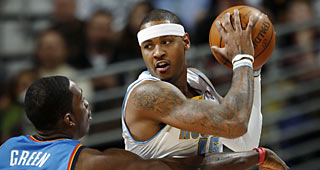
Here at the outset of this article, it is important to mention that I am relying on the reporting of others as the foundation for this piece. Both Adrian Wojnarowski and Marc Spears have done good work on the Carmelo Anthony situation this summer and this serves as an interpretation of possible paths ahead rather than new journalistic ground.
The best place to start this is with a tale of two cities.
Last summer, both Toronto and Cleveland had decisions to make as their marquee players were to become free agents at the end of the season. The Cavaliers believed reasonably that LeBron James could (would?) return to them, so they focused on making the team better with him as the focal point.
On the other hand, while absolutely affected somewhat by hindsight, it still looked intensely unlikely that Chris Bosh was staying in Toronto beyond 09-10.
Moving forward, both teams held firm on their player. While both ended up leaving their old homes, Cleveland appeared to have a fighting chance with James, while Toronto did not even get a phone call from Bosh after the season ended.
Cleveland's decisions (in terms of this narrow point) made sense, as they knew James was an atypical commodity for them and they reasonably believed they had a chance to keep him.
In comparison, Toronto did not maximize on their investment as they did not even make the playoffs in the year they kept Bosh and got the same pittance as the Cavaliers, partially thanks to Miami?s cap situation and all three max guys taking a little less money.
What Denver can learn from this summer is the same lesson we learned from Kenny Rodgers- you have to know when to hold ?em, know when to fold ?em.
Once Carmelo Anthony shifts from the LBJ situation where you feel you have a fighting chance in free agency to a Bosh situation where that chance is illusory or non-existent, it is time to sell. That is a decision only they can make, but the timing is extremely important here.
The Carmelo situation is particularly interesting because there are three distinct time periods where he could change addresses, each of which has its own advantages and disadvantages for all involved parties.
The easiest time period is the one after this coming season. If Melo decides to leave, the best guess is that the price would be similar to Bosh and James, with Denver having additional leverage (and assets back) if the new team has less financial flexibility than Miami did.
The second circumstance is trading Carmelo before this season starts. One major change here is that Carmelo would be able to sign an extension with the trading team right now, which both decreases the long-term risk for him and his future team and increases what he can yield in a trade as it comes to Denver. The other additional nuance here is the possibility of a team ?renting? Carmelo for this year. Since the renting team would still have the opportunity to sign Carmelo (or at least pick up the picks from a 2011 sign-and-trade), they would still have to pay a little bit of a premium, especially since Denver would be losing out on a season of their best player despite the possibility of it being a lame duck year.
By far the most interesting potential team here is the LA Lakers. An Andrew Bynum for Carmelo Anthony trade works straight up, as do a few different variants. For Denver, it likely represents the best return they can get on Carmelo- after all, think about whether Toronto would take that over two first round picks from Miami.
For the Lakers, they lose a young asset but at the worst become the clear-cut favorites for the 2011 title and keeping all but one rotation player beyond next season. The best case is that Melo re-signs and they have a core that easily rivals and likely outpaces Miami for at least a couple more years.
The other potential rental destinations are Portland (they have the assets to make a deal Denver could take even without a promise to re-sign, though they may not do it) and New Jersey (see Portland). While it is inherently unlikely that this path is the one taken since most teams don?t have the guts to roll the dice like that, it is a possibility worth discussing.
Beyond that, the third option is to trade Carmelo to a team with an extension, much like the Kevin Garnett deal in the summer of 2007. Here, Denver has to cater to Melo?s whims to a degree since he can put the kibosh on any deal by refusing to sign an extension with that team. That said, they could have some leverage if the team would not have the ability to sign Carmelo outright in 2011 as well as a risk premium since they would have a franchise player locked in for at least the next four seasons.
The other factor here is that the financial security would be a big help for Carmelo?s peace of mind considering the looming lockout and potential CBA changes that are unknowns which affect Melo?s next contract. If they play it right, Denver could squeeze out a meaningful asset by holding the scepter of an uncertain deal over Melo?s head for the next few months.
The final option is to trade Anthony during the season without an extension, yet that is awkward because it is unlikely to achieve the goals of any party involved, though it is possible that Denver could end up getting more cutting bait at the trade deadline than they would get in the summer.
The additional difference between this and other situations, most notably Chris Paul's with the Hornets, is that Denver does not have any particularly bad contracts on their books. The Nuggets do not have a single player signed for more than the MLE on their books beyond 2012, and all of their big 2011 contracts are option years (Melo and Nene have player options while the Nuggets have a team option on Chauncey Billups). This salary flexibility means that Denver does not have to focus on using Carmelo to shed another deal should they decide to trade him and can instead focus on bringing back assets in return.
Simply put, those are the different ways this can shake out.
If Denver reasonably believes that Carmelo could change his mind and come back, it would make sense to keep him around. The guy is a great player and it is awfully hard to replace him either in a trade or free agency. However, if he moves into Bosh territory, they should move deliberately. While Melo does have substantial leverage by limiting trade partners through his extension, the Nuggets can use both the uncertainty of the next CBA and the rental options to get a substantially better deal than both Cleveland and Toronto got earlier this summer.
I sincerely hope Carmelo is weighing all of the amazing potential landing places he has for 2011 and beyond, including Denver. While the 2010 free agent cities get a ton of pub for that, the 2011 group should have some very interesting teams as well, especially considering Melo?s personal history.
1. Washington- In my eyes, this is the perfect place for Carmelo if he wants to change addresses. As a kid who grew up in Baltimore, the Wizards represent a place where he can both be the face of the franchise and still have quality players around him. John Wall is going to be a stud sooner rather than later, and they have a nice little cluster of players in Andray Blatche, JaVale McGee, Trevor Booker, Kevin Seraphin, Kirk Hinrich, and Gilbert Arenas coupled with a great owner who will spend to make the team competitive.
2. Brooklyn/New Jersey- The borough where Carmelo was born provides another logical location. The Nets now have a starting big man core in Brook Lopez and Derrick Favors along with a swingman in Terrance Williams who would serve as a nice foil to Anthony. CSKA Brooklyn also has strong ownership that will spend to compete and allows Carmelo to be the face of the franchise while having a legit team around him.
3. New York- Some reporting has the Knicks has the long-term favorites to sign Anthony, and it is easy to see the appeal. As the high profile team in America?s biggest city, the Knicks have some major advantages. They also have young talent in Anthony Randolph, Danilo Gallinari, and Wilson Chandler, though I?m skeptical of the fit of Chandler or Gallinari with Melo. The other challenge here is that there simply is not a way under the current CBA for New York to add both Carmelo and Chris Paul barring complete charity from their current teams. Without a meaningful first round pick for a while, the Knicks provide a good situation from a talent perspective, but not the same appeal as the Nets or Wizards.
4. Houston- An interesting destination because they have assets to make a deal that Denver would accept if Carmelo decides to go here. Incidentally, Dallas may have taken themselves out of the running here by moving Erick Dampier?s instantly expiring contract. Back to Houston, they have the combination of talent to both make a deal and still have a very strong team featuring Carmelo as the #1 offensive option. It is legitimately scary to think of how good a combination of Anthony and a healthy Yao Ming could become.
5. Orlando- Only accessible through a sign-and-trade, adding Melo to the Magic would make them an unbelievably good team. The challenges here are figuring out what Denver would value that Orlando can trade (since they have no bad contracts for the Magic to eat) and how exactly Orlando could pay Dwight Howard, Rashard Lewis, and Carmelo Anthony at the same time.
6. LA Clippers- A team that has both young assets like Eric Gordon and Al-Farouq Aminu and a guy like Chris Kaman who would make some sense in Denver if they want to move in a very different direction long-term. Blake Griffin, Baron Davis, and Melo would be an amazing core, regardless of what the other pieces are around them and could become the team that battles with Oklahoma City and Portland for NBA Finals berths down the road.