RealGM Analysis
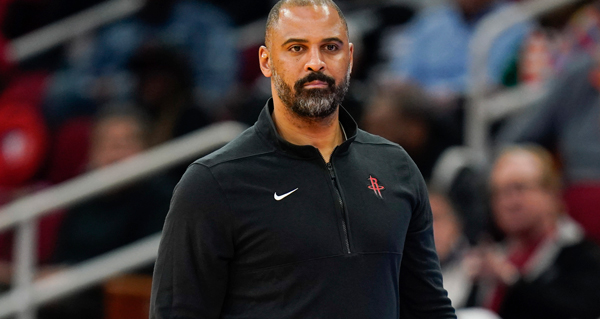
When Ime Udoka took over as head coach of the Houston Rockets in 2023, he brought with him a dogged commitment to defense.
“Every team that’s won a championship is usually a top-five ranked defense,” Udoka told The Ringer in his second season. “That’s a nonnegotiable for me.”
And yet it’s that nonnegotiable approach to defense that is among the biggest reasons why the Rockets find themselves in a 0-2 hole to the Los Angeles Lakers in the first round of the playoffs.
But before it was a bug, Udoka’s prioritization of defense was a feature. The word “refreshing” isn’t the first one I’d use to describe Udoka’s style, but it was a restorative approach considering that Houston had been one of the league’s worst defenses under the previous regime.
Dillon Brooks and Fred VanVleet, along with Udoka, injected a roughneck mentality into the locker room. What had been a jumbled mess of young players trying to figure out their individual NBA voices became a connected group that started and ended every game thinking about how it could stop the opponent from scoring.
That first season, the Rockets finished the year with the league’s seventh-ranked defense (when subtracting garbage time, per Cleaning the Glass) and 19 more wins. They did it by following Udoka’s three tenets of defense:
1. Guard your yard
“We’re only as good as our one-on-one defense,” Udoka told The Ringer. “We’re only as good as all our five on the court, and any weak link is exploited.”
As we’ll get to shortly, this helps explain Udoka’s approach to his lineups.
2. Take away three pointers
Related to the first point, the Rockets aren’t going to over-help. They want to guard everything one-on-one and stay home on shooters, even if it means giving up the occasional easy bucket in the paint.
3. Defend in transition
Udoka’s team went from ranking dead last in transition defense to third in his first year, per Cleaning the Glass. Not only did players buy into getting back, but Houston’s relentless drive crashing the offensive glass prevented teams from leaking out.
It’s hard to argue that these things didn’t work. Udoka’s Rockets have never ranked outside the top 10 in defense and won 52 games in each of the past two seasons.

But sometimes a correction can veer into overcorrection territory, and it seems that may be happening through two playoff games against the Lakers.
The Rockets have held the Lakers to a 113 offensive rating – a mark that would have ranked in the bottom 10 of offenses in the regular season. That’s good! But they themselves have failed to crack 100 points in the opening two bouts. That’s bad.
Even after getting Kevin Durant back from a Game 1 absence, the Rockets managed a meager 94 points in Game 2. Durant scored 20 points in the first half of his return from a knee injury but was held to just three points in the second half.
The Lakers’ decision to double Durant played a big role in getting the ball out of his hands. They used this strategy to fuel two wins against the Rockets in March and dusted it off for Game 2.
Durant took just five shots in the second half and committed as many turnovers. For as amazing a scorer as Durant is, he leaves a lot of meat on the bone as a playmaker. The Lakers’ doubles forced him to rush passes or fumble the ball altogether. Houston scored at a rate of 74 points per 100 possessions in the halfcourt (which is barely scoring).
The Lakers were free to double Durant because the Rockets didn’t provide any sort of valve to relieve the pressure. Nobody is afraid of Josh Okogie or Tari Eason one pass away.

Now is a good time to bring up that Reed Sheppard played only 10 minutes in Houston’s Game 2 loss, and only 14 situational seconds in the fourth quarter when the Rockets offense grinded to a standstill.
This goes back to Udoka’s tenets: “We’re only as good as all our five on the court, and any weak link is exploited.”
Udoka’s aversion to playing his weaker defenders in big moments is the only reason why Okogie, a career journeyman and 31% outside shooter, would play 2,129% more than Sheppard, the former No. 3 pick, in the fourth quarter of a playoff game. For whatever Sheppard gives up defensively, placing him a pass away from Durant is an easy way to counter LA’s double teams.
(For the record, I think Sheppard’s defensive deficiencies are overstated. No, he’s not a great athlete and bigger players can shoot over him, but he has quick hands, good instincts, and forces turnovers.)
The crazy part is that Udoka literally made this adjustment in the regular season. After those two Lakers losses in March, Sheppard started 10 of the next 11 games. The Rockets won eight of those games.

Then, poof. He was back on the bench. If anything, Udoka has leaned further away from playing his best non-Durant shooter. Sheppard played 17 and 21 minutes next to Durant in those two regular-season meetings. He shared the court with KD for just 8.6 minutes in Game 2.
Durant’s limitations as a passer were on full display in the regular-season matchups and in Game 2. Part of a coach’s job is to make the job of his star players easier. Udoka’s approach is almost the opposite. Instead of designing an offense that gives Durant room to cook, he calls No. 7’s number and goes back to thinking about defense.
Clearly, Udoka is wary of LeBron James targeting Sheppard on defense. That’s a fair concern, especially with Alperen Sengun at center. Ask the Knicks how hard it is to cover up for two minus defenders in the spine of your defense.
But it would also help if Houston could force the Lakers to take the ball out of their own basket. The Lakers’ most efficient offense was running off live rebounds (they added 8.1 points per 100 possessions off live rebounds, which would rank in the 100th percentile, per Cleaning the Glass). Scoring more would help Houston’s defense.
On one hand, Udoka’s unwavering commitment to defense is a reason why the Rockets are here. It’s the team’s identity, and it’s hard to argue with consecutive 50-win seasons. But they are also down two games to none right now because they can’t score against a Lakers roster that isn’t exactly flush with elite defenders.
It’s a tricky thing about the playoffs: Weighing how much to stick to the principles that got you here versus making the ad-hoc adjustments needed to survive. We’re about to see just how non-negotiatiable Udoka’s defense really is.