RealGM Analysis
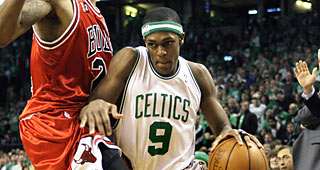
Things have happened rather quickly for Rajon Rondo. He was drafted by the Phoenix Suns with the 21st overall pick in 2006 and then flipped to the Boston Celtics along with Brian Grant for a future first-round selection.
Less than two years after his first Summer League appearance, Rondo helped guide a star-studded Celtics roster to a championship at just 22 years of age. With Boston?s chances of repeating vanishing with the knee injury to Kevin Garnett, the young guard took a brunt of the criticism as an aloof player with a suspect jumper last season.
Then, as if the pressure of winning another title for his three aging teammates wasn?t enough, rumors swirled this offseason that Celtics president Danny Ainge was shopping Rondo and that perhaps a contract extension was unlikely.
After a whirlwind couple of months, the Celtics signed Rondo to a reported five-year, $55 million contract extension prior to Monday?s league deadline.
The Celtics weren?t willing to give Rondo the type of deal he and agent Bill Duffy were looking for because they questioned his ability to lead and fit in with his teammates. Standing their ground, Rondo?s camp appeared ready to head into restricted free agency next summer as recently as a few days leading to the deadline.
With the original deadline schedule for Friday -- it was moved back to Monday because the usual deadline of Oct. 31 fell on a Saturday -- the overwhelming feeling at TD Banknorth Garden last Wednesday was that Rondo wouldn?t get the extension he felt he deserved because the Celtics wouldn?t budge.
Many members of the Boston media that I spoke with while covering the team?s home opener against Charlotte were on the fence. The most popular arguments were that Rondo wasn?t worth more than $13 million annually, that the team?s decline following the eventual retirement of Garnett, Paul Pierce and Ray Allen would be far steeper without the point guard and that the absence of a long-term contract for Rondo (and Allen, who is headed for free agency next summer) would severely hamper the team?s chances at contending for a title this season.
Of course, all of those arguments are irrelevant now that Rondo is under contract well into the next decade.
Prior to the agreement, Rondo and Duffy made it known that they were looking for a contract that put the former Kentucky Wildcat among the league?s top-five point guards. The deal he signed is believed to increase by roughly $1 million each season, meaning it begins at $9 million in 2010-11 and ends with $13 million for the 2014-15 campaign.
Let?s see where Rondo will rank among the league?s highest-paid point guards next season, the first year of his new contract:
Fifteen Highest-Paid Point Guards
Gilbert Arenas, Washington - $17.7M
Deron Williams, Utah - $14.9M
Chris Paul, New Orleans - $14.9M
Tony Parker, San Antonio - $13.5M
Chauncey Billups, Denver - $13.2M
Baron Davis, Los Angeles - $13M
Monta Ellis, Golden State - $11M
Jason Terry, Dallas - $10.6M
Steve Nash, Phoenix ? $10.3M
Maurice Williams, Cleveland - $9.3M
Rajon Rondo, Boston - $9M
Kirk Hinrich, Chicago - $9M
Jose Calderon, Toronto - $9M
Devin Harris, New Jersey - $8.9M
Andre Miller, Portland - $7.2M
It?s almost comical to think that Rondo and Hinrich will be in the exact same tax bracket in 2010. At this point I might take Harris over Rondo, but the former is significantly closer to his ceiling than the latter. Looking at the guards that will earn more than Rondo next season, the only ones I?d prefer right now are Williams, Paul, Parker and Billups. Arenas (attitude and health) and Nash (age and health) scare me.
Over the remainder of their contracts, D. Williams (four years at $15.6M), Paul (four, $15.6M), Parker (two, $13M) and Billups (three, $13.1M) will all average significantly more annually than Rondo (five, $11M).
Now let?s look at how Rondo ranked among the league?s best point guards, in terms of FIC per 40, last season:
Ten Highest-Ranked Point Guards
Paul, NOH ? 22.5
Williams, UTA ? 17.8
Nash, PHX ? 17.6
Rondo, BOS ? 17.4
Kidd, Dallas ? 17.1
Calderon, TOR ? 16.6
Parker, SAS ? 16.4
Billups, DEN ? 15.4
Harris, NJN ? 15.3
Nelson, ORL ? 15.1
Paul was second only to LeBron James in terms of total FIC and FIC/40 last season, but no one had a better Reina Value (+1,049%) than Rondo. For those that aren?t familiar with Executive Editor Chris Reina?s FIC statistic, it is similar to other per minute efficiency ratings but tends to treat playmakers better.
Rondo led the Celtics in FIC in both the regular season and playoffs last year, and was third (ahead of Allen and behind Garnett and Pierce) in FIC during Boston?s championship season.
To borrow a line from Kendrick Perkins, all of Rondo?s numbers, including his FIC, would likely be higher if he touched the ball as much as Paul, Williams and Nash. Last season, CP3 had a ?Hands-On? percentage of 51.2%, meaning he either made or assisted on more than half of New Orleans? baskets. Williams (37.8%), Nash (33.9%) and Rondo (33.8%) were all among the league leaders, but a vast gap separates them from Paul.
I?m not taking anything away from Paul, but rather putting his eye-popping statistics into perspective. It?s also ironic that we?re debating the value of Paul/Rondo just days after the pair appeared to do the same on the court.
Top-Ten in PER
Paul, NOH ? 30.0
Parker, SAS ? 23.4
Harris, NJN ? 21.6
Williams, UTA ? 21.1
Nelson, ORL ? 20.6
Nash, PHX ? 19.5
Rondo, BOS ? 18.8
Billups, DEN ? 18.8
Calderon, TOR ? 18.7
Kidd, DAL ? 16.9
PER, the most famous statistic of ESPN?s John Hollinger is also a very useful metric. The league average stands at 15.00, which puts the above point guards in the above-average category. However, it is a very offense-heavy statistic, something Hollinger himself will admit. Rondo is a better defender than most of the players I?m comparing him to, arguably the best at the position.
Another thing that must be considered when analyzing Rondo?s PER rating is that he?s not thought of as a polished offensive player -- yet. Yes, his court vision and handle are very good, but he will certainly continue to grow as a weapon in his own right. He?s starting to show flashes; he used floaters and nifty moves around the basket to score 11 points on seven shots against the 76ers on Wednesday night. He prefers to pass the ball, despite his supposed ?ego,? which lends to good shot selection.
As the Big Three age, we?ll see Rondo?s shots increase. That gives him time to refine a jump shot that is already better than it was when he entered the league.
Top-Ten in On/Off per 100 Possessions
Paul, NOH: +19
Nelson, ORL: +18
Rondo, BOS: +13
Billups, DEN: +11
Calderon, TOR: +11
Kidd, DAL: +10
Parker, SAS: +5
Williams, UTH: +5
Nash, PHX: +4
Harris, NJN: +2
On/off numbers are trendy right now, especially with the controversy over Kevin Durant?s +/- tally. Rondo, playing for a very good Celtics team, had a strong number, which was in fact better than the team?s overall points per 100 possessions rating of +8.2. A player?s team has a substantial effect on their on/off numbers, but there is something to be mined from this data.
For one, the Celtics don?t have a strong point guard behind Rondo, which not only puts him on the court for more than thirty minutes a night but also leaves him on the floor in different situations. I?d argue that Boston?s offense slows down without Rondo, due to the lack of a traditional point off the bench, and that no one Doc Rivers uses in the role is as good defensively as Rajon.
So, what do all the numbers mean?
While Rondo certainly stepped into a very advantageous situation when he landed in Boston, he?s a very good player in his own right and has the potential to be even better. If you think he?s riding the coattails of the Big Three, you?re quite wrong. His skinny frame and, at times, unreliable jumper may be masked by the wealth of talent around him, but the Celtics will have a great player to build around when the current incarnation of the team is decimated by retirement.
For example, Kendrick Perkins, Boston?s fifth starter, averaged just two minutes per game fewer than Rondo last season, but his numbers were far less impressive. Detractors will point to the difference in positions, but the figures are staggering.
Perkins? PER rating from last season was 13.2, below the league average. His on/off per 100 possessions are +5, far lower than that of Rondo (+13). As if that wasn?t enough, his FIC per 40 was +12.8 and his Reina Value was +61% when putting just $4.5 million contract against his production.
The next question -- Is Rondo worth a five-year, $55 million deal?
The short answer is yes. He ranked 16th in total FIC last season. While that doesn?t necessarily label him as the 16th-best NBA player from 2008-09, he was at least on that level of production. Vince Carter ($16.3M) has the 16th-richest contract this season. Carrying his production over, you could rationalize that Ainge would have gotten his money worth had Rondo earned $16.3 million last season.
He will eventually make $13 million during the 2014-15 season, but his deal will be a relative bargain for at least the next four seasons. He?s under his rookie contract currently, after which he?ll make $9 million, $10 million and $11 million in consecutive seasons. He?d have to severely stray from his current production in order to be thought of as overpaid.
Rondo felt as though he was worth more, and probably could have gotten a larger contract from either a different team or at a different time. The Celtics already have a lot tied up in other players and the NBA?s cloudy financial picture has made every front office a little leery.
?The rumors were strange considering [Rondo?s] importance to the team, but that?s just how the league is today,? a league executive told me last week. ?In the late 1990s, they would have given him a huge deal without thinking twice. The economic structure of the league has greatly affected contract talks for guys like him.?
As the executive hints, Rondo isn?t worth a maximum contract, but likely would have gotten a larger contract if it was 1999 instead of 2009.
Grade for Rondo: B
If he waited to hit restricted free agency, Rondo may have gotten more money from either the Celtics (with Allen?s contract expiring) or another team with cap space that missed out on top-level free agents like LeBron James, Dwyane Wade and Chris Bosh.
However, the situation is very cozy in Boston. He?ll have help from the Big Three this season and at the very least the Big Two for two more seasons. That should keep the team playing at a high level and keep him from the often dubious status of being the team?s highest-paid player until at the very least the 2012-13 season (and very likely longer with Pierce looking to play past his current contract).
With that said, if Rondo?s play dips or he gets injured this season, he locked himself into a very solid financial situation well into the next decade. Just look Jets running back Leon Washington, who held out for a bigger deal, deciding against signing an extension with the team. His season ended due to a devastating leg injury and the decision probably cost him millions of dollars.
Grade for Boston: A-
Ainge could have buckled, even with the team?s high payroll, in order to appease Rondo and make sure an extension was reached much prior to the deadline. Instead, he waited and it appears as though Rondo and his agent made more concessions than Boston did.
The Celtics are expecting Rondo to continue to progress as a man and a player. He has time to improve both his leadership and offensive skills before the team will need him to carry a heavier load than he is currently.
The danger for the Celtics is evident, but the risks of not signing Rondo to a new deal were very real. If he explodes this season, his price tag rises. He could also have taken the lack of a deal as an insult, opting to look for the most unmatchable deal he could find at the end of the season. In addition, Ainge knows that Boston?s championship window is probably only open for another two seasons, making a happy Rondo a very important part of the team?s plan.
The argument has also been made that as important as Allen, Pierce and Garnett are, Rondo is more indispensable. If Garnett goes down again, the Celtics have Rasheed Wallace and Glen Davis. If Pierce or Allen goes down, they have Marquis Daniels. If Rondo does down, they are left with Eddie House at point guard. For his career, House has averaged just 1.6 assists per game.
Risk was averted on all sides.
Andrew Perna is Deputy Editor of RealGM.com and co-host of RealGM's Radio Show. Please feel free to contact him with comments or questions via e-mail: [email protected]. You can also follow Andrew on Twitter: APerna7.
';
document.write(str);
}