
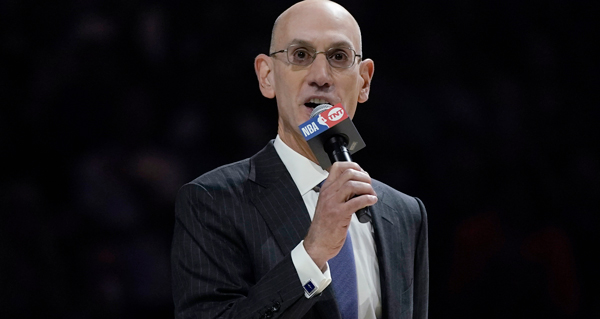
During a press conference on Tuesday, Adam Silver pushed back on the notion that the NBA's new collective bargaining agreement with a more punitive apron system is creating unintended consequences for the league.
NBPA executive director David Kelly said last week the system needs to be softened or eliminated and it is acting like a de factor hard salary cap that has forced teams into decisions unrelated to basketball.
"So it’s certainly not an unintended consequence," said Silver. "When you have a salary system in place as we do, every general manager is going to need to make mixed basketball and business decisions. Frankly, they make them regardless of whether you have a cap. You see that in other sports. People manage to budgets. People recognize that you can’t — at some point, you can’t have unlimited resources, whether it’s for a team or any business.
"In the case of a league, it’s in essence zero sum. So to the extent that [a team] doesn’t re-sign a player or chooses to trade a player, of course that player goes to another team.
"The purpose of the system is ultimately to create competition throughout the league, and from that standpoint, I think the system is working incredibly well. The goal isn’t necessarily to have a different champion every year, but we’ve had eight different champions over the last eight years.
"As I’ve said previously, one of the things we were hoping to accomplish in this latest collective bargaining agreement was to dispel this notion that only certain markets were in a position to truly compete. We just saw a Finals between, essentially, the largest market in the league in New York and one of the smallest markets in San Antonio.
"You all can tell me in terms of the media, but it seemed that there was not much of a storyline around market size, something I’ve been used to in all my years in the league. During the competition, it was focused on the composition of the teams, the particular players, the style of play.
"But to me, the storyline wasn’t big market versus small market. That’s one of the things that we set out to accomplish with the system, and from that standpoint, it’s working.
"In terms of collective bargaining and for David Kelly, of course, at the point we sit down to negotiate a new collective bargaining agreement, it’s their right, the players’ right to raise any issues they want. I’m sure there will be issues from our side of the table that we want to discuss as well.
"The problem is, when you look at any issue in the abstract, an issue that the players want or an issue that the teams want, that every collective bargaining agreement is a result of a series of compromises. That’s what this one is, as well. But certainly from my standpoint, from a competitive standpoint, the system is working very well."







 Basketball Wiretap RSS Feed